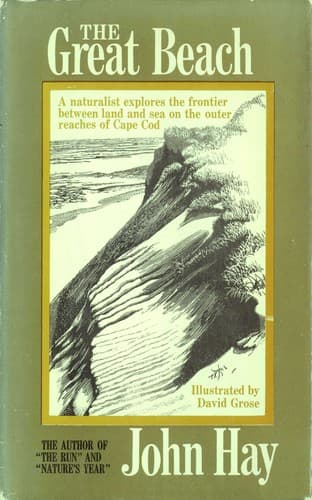
Cape Cod (Mass.) -- Description and travel; Natural history -- Massachusetts -- Cape Cod
Even now the history of Cape Cod is a history of enduring weather, of
the same exposures. Only our terms are not the same. Some years ago I
stood on the high hills of North Truro late one afternoon, watching the
suns red path shining and moving across the wide waters of the bay,
thinking of sea surfaces moving over the round earth to its poles,
and the poverty of the winter world around me, stripped to ultimates,
everywhere exposed, and exposed to everything. The round hills were so
bare that the little separate houses in the distance, down in hollows
or perched on the long slopes, seemed to shiver. They glittered like
so many frost flakes in the air. I had just come from Provincetown and
seen a dragger unloading its fish, and the fishermen cutting them up
with red, raw-meat hands. The wind was shipping up the water. The gulls
were crying over the racing, lathered shore.
It came to me that what had brought me here had not so much to do with
a feeling for the old Cape, with its churches in their simple New
England grace, or clam-digging, beach-combing, old wrecks, driftwood,
or fish weirs, real as it was in me, but a great new outwardness, a
universal human event. Each man undergoes a series of changes during
his lifetime in a sequence of experience that corresponds to that of
the world. He has in him the revolutions, the escapes from holocaust,
the interspaces of peace, the fact of war, the anxieties, the cry
that his being be fulfilled, the never-ending human examination and
measuring of things. So I found myself to be “way out,” a Cape Cod
term anteceding the Beat Generation, and meaning far from your home
base, with very few old promises behind to sustain me. I had to come to
terms with an age without age, a locality without location, perhaps a
divinity in fires of no precedent or name. Above all I was required to
change, to face in new directions.
* * * * *
The gulls floated in the cold air with customary ease. On my way home I
saw a great blue heron flying over a marsh and inlet, its broad wings
spread out like a cloak, long legs stretched straight behind it, with
feet curled up stiffly, head and neck crooked back. Then it landed
in shallow water. Its wings folded and it stood straight up, with a
surprising, statuesque height and gaze, the long neck and head above
a flock of ducks that were swimming and feeding near by, assuming
the kind of composure special to a race of herons that would serve
indefinitely. The wind ruffled the water, swept over reeds and curving
grasses, sending the last light of day roving in splendid colors over
the entire marsh.
Public-domain text, read in full here on John Shaqi.
Reviews
Reviews
No reviews yet
Be the first to share your thoughts on this work.
Join the Discussion
Join the discussion
Sign in to leave a comment or review.
Sign InorCreate an account