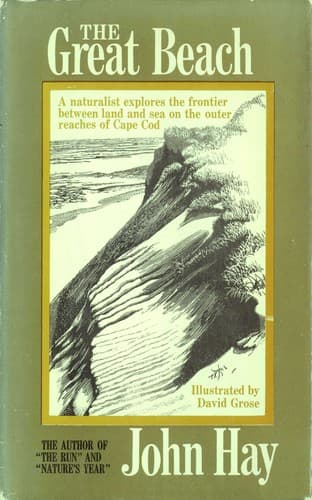
Cape Cod (Mass.) -- Description and travel; Natural history -- Massachusetts -- Cape Cod
All the measured lights and shadows of day and night, the tides of the
sea and the tides of the season, the response and joint association of
all life’s components in that place stayed much the same as they had
ever been, in spite of the way we hurled in our roads and relocated
ourselves without rest. Its natural order was still there for old
expectation to seize upon; though in terms of accumulated knowledge
and wants it was more complex than it had ever been, and would have to
endure a human association that was itself on the waters of change,
holding hard to the mechanics of its coming. Cape Cod had suddenly lost
a slow, accumulative history, perhaps in a matter of twenty years,
and would be treated like the rest of the world--as it happened, as
it would come about under human auspices. Our problem, one of many,
might be this: how could we reconcile universal commitment with the
inviolable nature of a single place?
VII
Barren Grounds
The oceanic landscape reaches across the round earth, over a curved
horizon, and that may be one reason why men keep returning to it. The
sea attracts the experience of distance. There is still some vicarious
adventure to standing on a cliff, breathing the far-ranging air and
imagining ships hidden by mists on the horizon, or unknown lands beyond
that, or even remembering lands once visited. Over there is where the
great passages of history have gone by.
As recently as fifty or sixty years ago, man and sea were involved in a
more personal alliance on Cape Cod, and its seamen once voyaged around
the world. At the same time there were some local inhabitants who
considered it a major expedition to go from one side of the Cape to the
other. The fishing, shipbuilding, and voyages to foreign lands that was
more characteristic of the Cape before the Civil War than after it gave
what might have been a too narrow community, concentrated only on its
own affairs, a healthy connection with the rest of the world.
Since the Second World War Cape Cod has been filled with relative
outsiders, many of whom have been transported, not necessarily through
any fault or wish of their own, to stations around the globe. A place
that once went out for its sustenance now waits for the world to come
to it.
One of the few people I met during my off-season walks on the beach
turned out to be a man who had retired from the city. The open air may
have been conducive to revelation, because he told me a great deal
about his life during the ten or fifteen minutes I talked to him.
It turned out that the place where we stood had some significance
in his own history. He looked out to sea from the edge of the cliff
and pointed out over the water to show me the general region where
transports used to gather during the First World War on their way
overseas. He had been on a Navy escort vessel.
Public-domain text, read in full here on John Shaqi.
Reviews
Reviews
No reviews yet
Be the first to share your thoughts on this work.
Join the Discussion
Join the discussion
Sign in to leave a comment or review.
Sign InorCreate an account