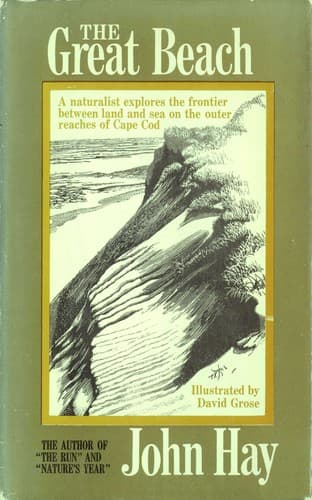
Cape Cod (Mass.) -- Description and travel; Natural history -- Massachusetts -- Cape Cod
“This country,” said he, “is waste,” as he talked about war, small
business, rough competition, lumbering, and all the size and
circumstances of the men and societies he had met and fought and
endured. Through a life-long experience of waste--or waste space--and
all his tired compliance with authority and anger against it, he had
saved room in him for voyages. He told me that he had come to live near
the sea so that he could walk along the cliffs and the beach whenever
he wanted to, and to look out, I guess, when he wanted to with a
relatively free command view of destiny.
After I left him I met another reminder of war, spread out for several
miles along the tops of the cliffs. It is now within the boundaries of
the National Seashore Park, and one day, when the beach grass takes
hold of its denuded areas, it will no longer be recognizable as a
military reservation, but when I first walked through it Camp Wellfleet
had just been formally disbanded. Although it was completely deserted,
its buildings and some of its installations were still intact. It had
been an antiaircraft post, and not of primary importance to a coast
which was not likely to be attacked, but I have heard local residents
speak of the constant, annoying sound of practice firing, which made
the walls tremble and the dishes fall off the shelves, and for several
years after the war ended fishermen used to protest that their boats
were in the line of fire.
The camp was in what geologists call the Wellfleet Plain. It was on
these bare levels above the beach that Guglielmo Marconi built his
wireless station and sent out the first transatlantic message in
January of 1903. The year before, he had built an elaborate structure
with twenty masts, and this had blown down in a heavy onshore wind.
The successful message, which took the form of an exchange between
Theodore Roosevelt and King Edward VII of Great Britain, was sent from
only four masts, which had more stability in Cape Cod weather. It is
typical of the Outer Beach that although Marconi transmitted waves that
crossed the world, the sea has had the last word. On the day I walked
through nearly sixty years later there was nothing left of what he had
constructed but a few fallen bricks on the face of the cliff.
Marconi’s towers were long gone, but the Camp Wellfleet lookout towers
and firing range were still more or less intact, and the place only
lacked occupation to make it come alive again. The public had been kept
out of the area for many years, but now I could walk in on a winter’s
afternoon and not meet a soul. I passed a sign saying: MILITARY
RESERVATION NO TRESPASSING, not without vague qualms, and memories of
my own months in an Army camp, half-expecting the sound of “Halt!” to
ring out.
“Yessir. Yessir.” I said to myself, starting to prepare my excuses to
some ghost of past authority.
Public-domain text, read in full here on John Shaqi.
Reviews
Reviews
No reviews yet
Be the first to share your thoughts on this work.
Join the Discussion
Join the discussion
Sign in to leave a comment or review.
Sign InorCreate an account