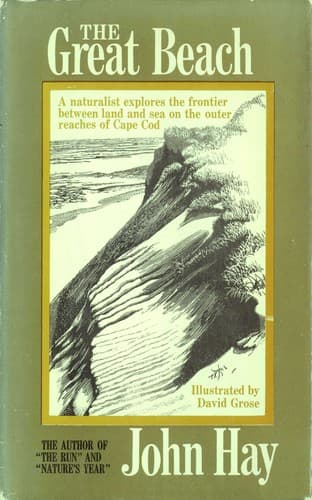
Cape Cod (Mass.) -- Description and travel; Natural history -- Massachusetts -- Cape Cod
It is murderous not to be able to fight back. It is also appropriate
for the Army to denude the ground of its grass, the beach grass that
holds it down above the cliffs. It is appropriate for the sea to roam
on with a blind eye, and for the cliffs to fall and the sands to shift
and blow. It is inevitable, at one time or another, that each of us
should stand on these barren grounds. The gloom of the sea puts all
other darkness and gloom in jeopardy. Its brilliance is impenetrable.
It carries light over the earth’s surface like a turning crystal. It is
overbearing and restless and at the same time as strict and balanced
as its tides. Perhaps it is best approached in misery of soul, because
then it stands out in all its cryptic mastery as the raw room that owns
us, the desert without illusion.
Camp Wellfleet had eight towers, spaced along the top of the cliff
for several miles. Watchers could look out from their transversing
positions over the coastline and the sea and signal the accuracy of
the antiaircraft gunners who fired at mobile targets over the water.
I climbed two of the towers that still had ladders. They were in fair
condition, but clearly not too long for this world of wind and spray,
of ice, rain, and snow, and the fierce summer sun. Most of the windows
were broken, the wires ripped off the control boards, and the floors,
with boards splintered or gone entirely, were littered with wire and
broken glass. A cold wet wind whined through. I wondered how many young
men had felt cast off, lonely, and bored on this lookout over the dark
sea. Some of those on duty had left their names behind, probably after
the war was over, judging by the dates: Sweeny, Morton, Yarborough, and
they also left the names, portraits, or disfigurements of their girls,
or would-be girls, the signs of need in wastes of order.
Concrete gun emplacements and bunkers were still intact, with empty
cartridges and ammunition boxes on the ground outside. A strand of
barbed wire made a little clanging sound of unused warning as I brushed
by it. Toward the far end of the reservation, on the Eastham side,
I passed another off-limits sign and sat down on a ring of sandbags
located in a little hollow on the very edge of the cliff; they were
beginning to slide down the face of it like Marconi’s bricks. Looking
down on the beach where blackbacks and herring gulls were the only
sentinels, facing in to the wind, I thought of how many worlds, how
many inventions, how much devising we had run through, at a faster
rate even than the sea cut down the cliffs. The maniacal weight of one
war had gone, but the knowledge and power it let loose had sent us on,
committing us to our human ends in the most inclusive and at the same
time isolated sense, universally vulnerable.
[Illustration]
Public-domain text, read in full here on John Shaqi.
Reviews
Reviews
No reviews yet
Be the first to share your thoughts on this work.
Join the Discussion
Join the discussion
Sign in to leave a comment or review.
Sign InorCreate an account