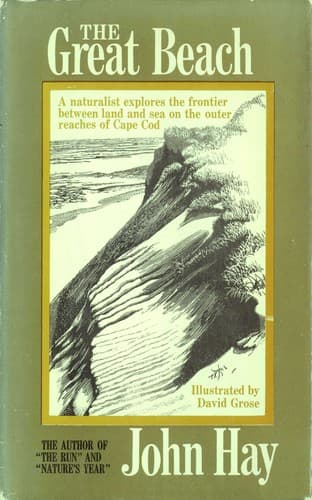
Cape Cod (Mass.) -- Description and travel; Natural history -- Massachusetts -- Cape Cod
The wind sent dark clouds of ruffled waters along the sea surfaces,
surfaces that tilted and flew, stretching away and disappearing, and
the sky light, feather gray in the rain, reflected everywhere. The long
surf line sounded with the crash and rattle of stones. The vast flow
went on unhindered, restless and controlled, delivering and holding
back, a nay and yea sayer at the same time, passing all experiments,
accepting all possibility without a care. How could the sea do anything
about reassuring mankind as to whether or not we would survive our own
acts and commitments? Did man make war, or did war make him? Perhaps we
love the sea for its denial of us.
Sitting on the sandbag, I thought of the GI who had last been there,
manning a gun now replaced by missiles and rockets--bothered perhaps
by the cold, penetrating wind, feeling useless, waiting for his
discharge from the Army, wishing he were somewhere else, not knowing
beach grass from seaside goldenrod, or one gull from another, but
knowing the sea, with its one sound.
VIII
A Landscape in Motion
There are a number of elevations on the Cape from which it is possible
to see both sides, getting above intervening houses, trees, or hills.
On the same Wellfleet Plain where Camp Wellfleet was located the
moraine tilts all the way down from the cliff above the Outer Beach to
the shores of the bay, and reaches of land and water come into view
from all directions. One plane leads to another by easy transitions.
The cliff tops shine in the wind above the steady pouring sound of
the waves and the dancing of molten gold and silver on the sea. Beach
grasses glitter. The land ahead is full of coarse scrub oak and green
patches of bayberry moving toward dark green woods of pitch pine and
clusters of houses, reaching the sheltered shores of the bay beyond
them, with salt marshes, gold and red; water-shining, brown tidal
flats, and a rim of blue water on the distant horizon.
It is a stunted land, not overhospitable to life by the looks of it,
although flocks of chickadees bounce gaily through the scrub as if
giving it their free acknowledgment. As the autumn progresses the reds
change to brown, plants darken or die down, shrubs lose their leaves,
and the grasses bleach. In all seasons it is a place of low growth,
ready in its hardy way to receive what the wind and sun can send it.
The sky is very wide overhead. You can see from one tidal area to
another--almost from one climate to another--standing on the bare
ground. In scale the view approximates what you can see from high in
the air.
Public-domain text, read in full here on John Shaqi.
Reviews
Reviews
No reviews yet
Be the first to share your thoughts on this work.
Join the Discussion
Join the discussion
Sign in to leave a comment or review.
Sign InorCreate an account