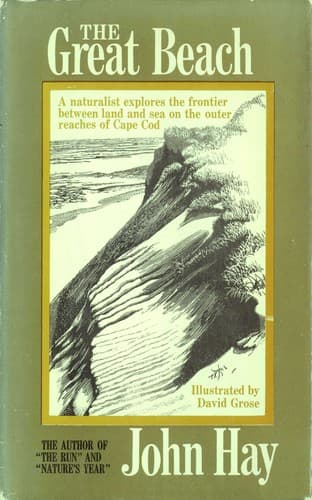
Cape Cod (Mass.) -- Description and travel; Natural history -- Massachusetts -- Cape Cod
Each life proves the need of all others. In a miraculous way, as each
natural form is miraculous, the single is also manifold. The rabbit,
as it nibbles grass, calls in the hawk. The spider is related, in its
reproduction and survival, to the insect it eats. The soil requires
microbes to break it down. The growth of plants is directed toward
capturing the energy of the sun. Life calls life in the context of
earth, water, and sky.
Throughout the wide landscape are a succession of environments, with
communities adapting to constant change, characterized by so much
mutual attraction and repulsion, so many delicate balances, such a
variety of response to influence inside and out that there is hardly a
stopping point for attention. We study particular environments so as to
predict and understand the behavior of animals, the reaction in plants
to variations in the intensity of light, or to relative moisture, or to
the chemical constituents of the soil. Each place has its character,
its complexity, and bounds.
But environment is more a characteristic of range than a separation in
its own right. All migration says so. The division between a pond and
its surrounding woodland is fairly distinct. A pond is an entity unto
itself. So is the division between salt water and fresh. But the frog
that lays its eggs in a pond may travel through the woods during the
summer. The salmon, the alewife, and the shad reproduce in fresh water
and grow up in the sea. Eels do the opposite.
In a sense each area has its representative, like the water birds,
from petrels that spend most of their lives over the open ocean, to
fresh-water ducks dabbling among the reeds. There are herons adapted
to spear fishing in the shallows; terns that dive for fish in surface
waters; others that swim after them under the water. Some of the
adaptations are so precise that if the particular food supply of a
species is endangered, so is existence of the bird itself.
On the other hand the very distinctness of each species, sharp-billed,
webfooted, with gliders’ or divers’ wings, seems to impart range to
countless others, those which exist and have existed, those which
may develop in a vast and unknown future. The difference, the space,
between a gannet and a dovekie, a great blue heron and a frigate bird,
proves all the depths of opportunity.
As I look out on the waters to east and west, to north and south,
I either see or envisage banks of fog far offshore, warm summer
squalls, biting cold air, torrents of brilliance in the sky, leaping
and ponderous deliberation in the waves. Warm air meets me from the
Bahamas, cold air from the Arctic, and the migrants pass me as they
travel in between. This earth, regardless of man’s construction of it,
is always re-relating its contexts, playing out new themes ahead.
Public-domain text, read in full here on John Shaqi.
Reviews
Reviews
No reviews yet
Be the first to share your thoughts on this work.
Join the Discussion
Join the discussion
Sign in to leave a comment or review.
Sign InorCreate an account