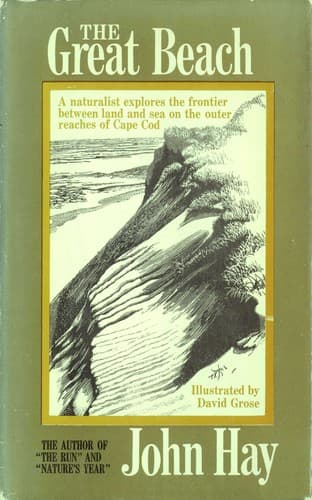
Cape Cod (Mass.) -- Description and travel; Natural history -- Massachusetts -- Cape Cod
In this distance, near to far, there is force, and its limits, a
counterbalancing as well as intermingling in the land, weather, and
tides, and in almost hidden terms the concurrent response of countless
inhabitants: the seed makers and dispensers, the hole diggers, the
fliers, scuttlers, and divers, those that swim, crawl, or walk. They
take part in range after range of consumption and growth, of trials and
failures, with endless patience, sudden quickness, flows of energy,
going through death and the travel-round of reproduction. They are
dancers in a realm that knows where all its leadings are.
There are dynamic secrets underfoot. Lives dawn of which we are
entirely unaware. Can we bring ourselves down to their great
participation, waiting through dawns, attending the sun, hiding under
the reality of wind and storm, where obedience means praise? Here
is that universal guarantee of novelty and increase which we try so
narrowly to imitate, substituting our simplicity for its complexity,
our distressed communality for its balanced crowds, our greed and
invention for its terrible provenance. Lord have mercy on us!
IX
Who Owns the Beach?
In the “off” and empty season, after the tides had erased all signs of
a hundred thousand human feet, it was hard to believe that the beach
could be owned or claimed by any one. It took on the air’s cold or
warmth, receiving, passing things on, from one day and seasonal mood
to another, not as on the land with its plant and animal reactions and
obstructions, the hiding; shadowing; coming forth intermittently; but
in bold and naked sight, reducing weather to its single qualities.
One day the Cape would be sunny and comparatively warm, and on the
next in would come the authentic northern wind, the polar air, roaring
and sweeping around with fierce abandon, riotously hard and cold,
freezing the ground, cutting at a man, diving on him with an icy
weight. The winter wind is so definite when it comes, overwhelming a
fairly moderate climate, where roses often bloom late into the fall
and hollies grow, as to make you think of icebergs, sliding down from
the north unexpectedly to stand hundreds of feet overhead. The sky,
threatening snow, writhes and purls up with gray clouds spreading
fanwise like auroras, and in the evening the sun goes down with a
coppery band on the horizon overhung by a bank of steely-blue clouds as
menacing as a shark.
Public-domain text, read in full here on John Shaqi.
Reviews
Reviews
No reviews yet
Be the first to share your thoughts on this work.
Join the Discussion
Join the discussion
Sign in to leave a comment or review.
Sign InorCreate an account