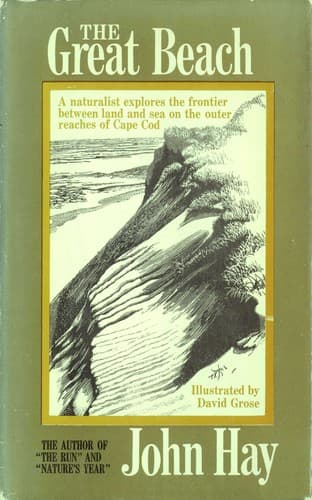
Cape Cod (Mass.) -- Description and travel; Natural history -- Massachusetts -- Cape Cod
And the great beach received what came to it, retaining its primal
right to a deeper breath and regularity, a harsh “poverty-stricken”
environment where man has no lease worth the paper. It did seem utterly
deserted, although the herring gulls and blackbacks flew up steeply
over the wind-buffeted waves, then banked and glided away, and draggers
occasionally moved parallel to the beach bucking the choppy seas, their
lines out astern. The wind threw stinging clouds of sand ahead of it.
Except for the fishermen and the gulls, it was an abandoned world,
glistening wide and cold, lost to importance and sense so far as human
society was concerned. For man there is no force quite so inclusive as
his own.
Since the beach is comparatively empty and isolated during fall and
winter, the sight of life on its sands may seem as rare as a rider
approaching you across the desert. I remember what an extraordinary
thing it seemed one afternoon to see a tiny red crab moving very slowly
along, high-legged over the bare slopes of the beach. I identified it
later as a species of spider crab. Green crabs, rock crabs, calico
crabs, and others are common along the protected shores of the Cape,
but out on this stretch of beach they are rarities. This baby, with
its beak, antennae, and eyes backed and covered by a knobbed and spiky
shell, seemed like an exotic from another world, which in fact it was,
having been flung in by the surf from rocks and seaweed forests in the
waters beyond it. It not only added to the beach, but to me, since it
made me realize that these sands were only shelving off into further
dimensions. The beach is a repository of freight, wreckage, and lives
from foreign lands.
This also happens occasionally on land. We all know that the sea is
out there, that the wind swirls over us, and the storms carry more
traffic than planes, but strangers sometimes appear as if to prove that
no place is what it seems to be. One spring a vermillion flycatcher
suddenly appeared in the neighborhood. I saw it in its exciting
tropical gaiety as it flew down next to a shining patch of spring rain
on an asphalt road. It is a native of Texas and New Mexico. Black
or turkey buzzards ride the great airs of spring and sometimes fly
northward, wheeling unexpectedly overhead. In November of 1962 I saw a
black stork, _Ciconia nigra_, which had somehow managed to make it all
the way across the Atlantic Ocean, perhaps managing to stop for rests
in such areas as Greenland and Newfoundland. It landed near the Coast
Guard Station, now National Seashore Park headquarters, at Eastham, in
an exhausted state, to be picked up by the Audubon Society and later
transported to the warmer climate of Florida.
Public-domain text, read in full here on John Shaqi.
Reviews
Reviews
No reviews yet
Be the first to share your thoughts on this work.
Join the Discussion
Join the discussion
Sign in to leave a comment or review.
Sign InorCreate an account