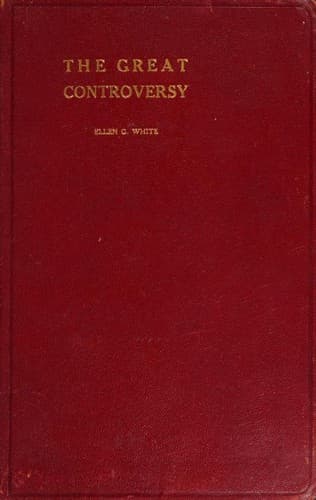
The Great Controversy Between Christ and Satan — John Shaqi
The Great Controversy Between Christ and SatanWhite, Ellen Gould Harmon
ReligionComparative
The Great Controversy Between Christ and Satan
White, Ellen Gould Harmon
Good and evil; Seventh-Day Adventists -- Doctrines; Spiritual direction
In the reign of Herod, Jerusalem had not only been greatly beautified, but
by the erection of towers, walls, and fortresses, adding to the natural
strength of its situation, it had been rendered apparently impregnable. He
who would at this time have foretold publicly its destruction, would, like
Noah in his day, have been called a crazed alarmist. But Christ had said,
“Heaven and earth shall pass away, but My words shall not pass away.”(33)
Because of her sins, wrath had been denounced against Jerusalem, and her
stubborn unbelief rendered her doom certain.
The Lord had declared by the prophet Micah: “Hear this, I pray you, ye
heads of the house of Jacob, and princes of the house of Israel, that
abhor judgment, and pervert all equity. They build up Zion with blood, and
Jerusalem with iniquity. The heads thereof judge for reward, and the
priests thereof teach for hire, and the prophets thereof divine for money:
yet will they lean upon the Lord, and say, Is not the Lord among us? none
evil can come upon us.”(34)
These words faithfully described the corrupt and self-righteous
inhabitants of Jerusalem. While claiming to observe rigidly the precepts
of God’s law, they were transgressing all its principles. They hated
Christ because His purity and holiness revealed their iniquity; and they
accused Him of being the cause of all the troubles which had come upon
them in consequence of their sins. Though they knew Him to be sinless,
they had declared that His death was necessary to their safety as a
nation. “If we let Him thus alone,” said the Jewish leaders, “all men will
believe on Him: and the Romans shall come and take away both our place and
nation.”(35) If Christ were sacrificed, they might once more become a
strong, united people. Thus they reasoned, and they concurred in the
decision of their high priest, that it would be better for one man to die
than for the whole nation to perish.
Thus the Jewish leaders had “built up Zion with blood, and Jerusalem with
iniquity.” And yet, while they slew their Saviour because He reproved
their sins, such was their self-righteousness that they regarded
themselves as God’s favored people, and expected the Lord to deliver them
from their enemies. “Therefore,” continued the prophet, “shall Zion for
your sake be plowed as a field, and Jerusalem shall become heaps, and the
mountain of the house as the high places of the forest.”(36)
Public-domain text, read in full here on John Shaqi.
Reviews
Reviews
No reviews yet
Be the first to share your thoughts on this work.
Join the Discussion
Join the discussion
Sign in to leave a comment or review.
Sign InorCreate an account