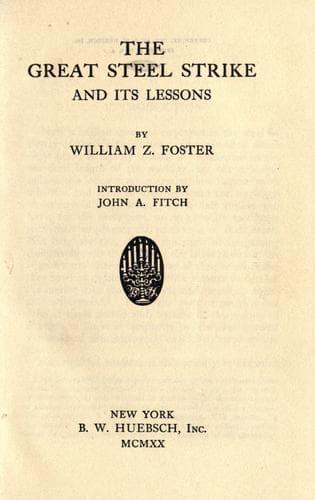
The Great Steel Strike and its LessonsFoster, William Z.
History
The Great Steel Strike and its Lessons
Foster, William Z.
Steel Strike, U.S., 1919-1920; United States Steel Corporation
In the immediate Pittsburgh district, due to the extreme difficulties
under which the organizing work was carried on and the strike
inaugurated, the shut-down was not so thorough as elsewhere.
Considerable numbers of men, notably in the skilled trades, remained at
work, and the mills limped along, at least pretending to operate. This
was exceedingly bad, Pittsburgh being the strategic centre of the
strike, as it is of the industry, and the companies were making
tremendous capital of the fact that the mills there were still producing
steel. Accordingly, the National Committee left no stone unturned to
complete the tie-up, already 75 per cent. effective. But under the
circumstances, with meetings banned and picketing prohibited, it was out
of the question to reach directly the men who had stayed at work. The
key to the situation was in the hands of the railroad men.
Operating between the various steel plants and connecting them up with
the main lines, there are several switching roads, such as the Union
Railroad and the McKeesport and Monongahela Connecting Lines. They are
the nerve centers of the local steel industry. If they could be struck
the mills would have to come to a standstill. The National Committee
immediately delegated organizers to investigate the situation. These
reported that the body of the men in the operating departments were
organized; that they had no contracts with the steel companies, and that
they were ready for action, but awaiting co-operation from their
respective national headquarters.
Consequently, the National Committee arranged a conference in Washington
with responsible representatives of the Brotherhoods and laid the
situation before them. In reply they stated that their policy was
strictly to observe their contracts wherever they had such, and that
their men would be forbidden to do work around the mills not done by
them prior to the strike. It was up to the men on the non-contract roads
and yards to decide for themselves about joining the strike. We informed
them then that the situation was such, with the men scattered through
many locals, that merely leaving it up to them was insufficient; it
would be impossible for them to act together without direct aid and
encouragement from their higher officials. We made the specific request
that each of the organizations send a man into Pittsburgh to take a
strike vote of the men in question, who are all employees of the steel
companies. They took the matter under advisement; but nothing came of
it, although long afterwards, when the opportune moment had passed,
organizer J. M. Patterson of the Railway Carmen (also of the Trainmen)
was authorized to take a strike vote. Thus was lost the chance to close
down these strategic switching lines and with them, in all likelihood,
several big mills in the most vital district in the entire steel
industry.
Public-domain text, read in full here on John Shaqi.
Reviews
Reviews
No reviews yet
Be the first to share your thoughts on this work.
Elsewhere in the archive
Join the Discussion
Join the discussion
Sign in to leave a comment or review.
Sign InorCreate an account