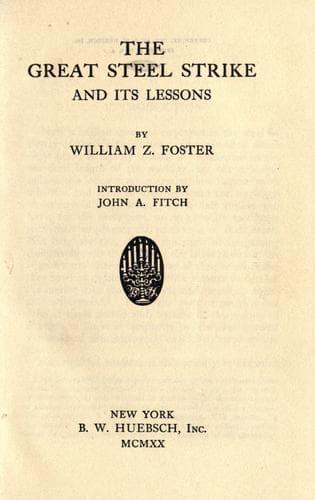
The Great Steel Strike and its LessonsFoster, William Z.
History
The Great Steel Strike and its Lessons
Foster, William Z.
Steel Strike, U.S., 1919-1920; United States Steel Corporation
This action by the unions will be a step in the right direction, but it
alone will not solve the vexed problem. The best negro leaders must join
heartily in destroying the pernicious anti-union policies so deeply
rooted among their people. It is a lamentable fact, well known to all
organizers who have worked in industries employing considerable numbers
of negroes, that there is a large and influential black leadership,
including ministers, politicians, editors, doctors, lawyers, social
workers, etc., who as a matter of race tactics are violently opposed to
their people going into the trade unions. They look upon strike-breaking
as a legitimate and effective means of negro advancement. Time and
again, they have seen their people, by use of it, readily work their way
into trades and industries previously firmly sealed against them by the
white workers' and white employers' prejudices. Nor can they see any
wrong in thus taking advantage of the white man, who has so brutally
oppressed them for centuries. On the contrary, they consider it a
justified retaliation. They are in a race war. Inasmuch as the steel
strike resulted in more negroes being in the industry than was the case
before, they look upon the outcome as a victory. For these elements, and
they are numerous and powerful among negroes, the color line clauses in
the union constitutions are meat and drink; such leaders don't want them
abolished,--they make too strong an argument against the unions.
Consider the situation faced by the unions in the campaign to organize
the Chicago packing houses in 1917-18. The negroes in this industry are
a strong factor (numbering 14,000 of a total of some 65,000 employees),
and the unions were determined to organize them. But no sooner had
organizers begun the work than they met the firm opposition of the negro
intelligencia above-noted. These warned their people to have nothing to
do with the movement, as their interest lay in working with the packers
to defeat the unions. They said that was how the negroes came into the
packing industry, and that was how they would progress in it.
Public-domain text, read in full here on John Shaqi.
Reviews
Reviews
No reviews yet
Be the first to share your thoughts on this work.
Elsewhere in the archive
Join the Discussion
Join the discussion
Sign in to leave a comment or review.
Sign InorCreate an account