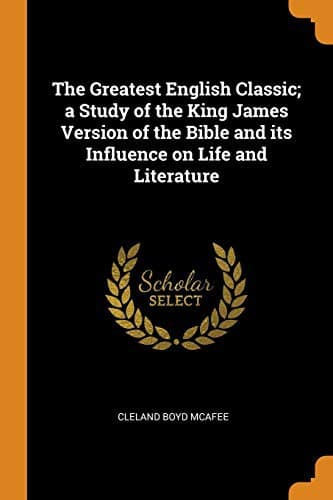
The Greatest English Classic: A Study of the King James Version of the Bible and Its Influence on Life and Literature — John Shaqi
The Greatest English Classic: A Study of the King James Version of the Bible and Its Influence on Life and LiteratureMcAfee, Cleland Boyd
History
The Greatest English Classic: A Study of the King James Version of the Bible and Its Influence on Life and Literature
McAfee, Cleland Boyd
Bible -- History; Bible -- Influence; Bible and literature; Bible. English -- Versions -- Authorized
In the century just after the Wiclif translation,
two great events occurred which bore
heavily on the spread of the Bible. One was
the revival of learning, which made popular
again the study of the classics and the classical
languages. Critical and exact Greek scholarship
became again a possibility. Remember that
Wiclif did not know Greek nor Hebrew, did not
need to know them to be the foremost scholar
of Oxford in the fourteenth century. Even as
late as 1502 there was no professor of Greek at
the proud University of Erfurt when Luther was
a student there. It was after he became a
doctor of divinity and a university professor
that he learned Greek in order to be a better
Bible student, and his young friend Philip
Melancthon was the first to teach Greek in
the University.[1] But under the influence of
Erasmus and his kind, with their new insistence
on classical learning, there came necessarily a
new appraisal of the Vulgate as a translation
of the original Bible. For a thousand years
there had been no new study of the original
Bible languages in Europe. The Latin of the
Vulgate had become as sacred as the Book itself.
But the revival of learning threw scholarship
back on the sources of the text. Erasmus
and others published versions of the Greek
Testament which were disturbing to the Vulgate
as a final version.
[1] McGiffert, Martin Luther.
The other great event of that same century
was the invention of printing with movable
type. It was in 1455 that Gutenberg printed
his first book, an edition of the Vulgate, now
called the Mazarin Bible. The bearing of the
invention on the spread of common knowledge
is beyond description. It is rather late to be
praising the art of printing, and we need spend
little time doing so; but one can see instantly
how it affected the use of the Bible. It made it
worth while to learn to read--there would be
something to read. It made it worth while to
write--there would be some one to read what
was written.
One hundred years exactly after the death of
Wiclif, William Tindale was born. He was
eight years old when Columbus discovered
America. He had already taken a degree at
Oxford, and was a student in Cambridge when
Luther posted his theses at Wittenburg. Erasmus
either was a teacher at Cambridge when
Tindale was a student there, or had just left.
Sir Thomas More and Erasmus were close
friends, and More's Utopia and Erasmus's
Greek New Testament appeared the same year,
probably while Tindale was a student at Cambridge.
Public-domain text, read in full here on John Shaqi.
Reviews
Reviews
No reviews yet
Be the first to share your thoughts on this work.
Join the Discussion
Join the discussion
Sign in to leave a comment or review.
Sign InorCreate an account