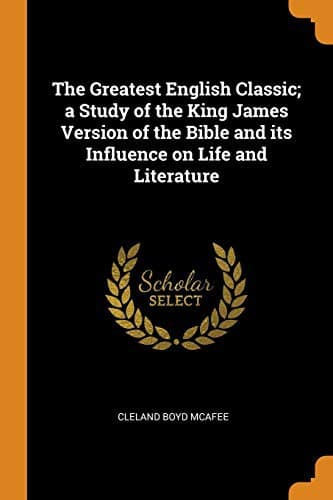
The Greatest English Classic: A Study of the King James Version of the Bible and Its Influence on Life and LiteratureMcAfee, Cleland Boyd
History
The Greatest English Classic: A Study of the King James Version of the Bible and Its Influence on Life and Literature
McAfee, Cleland Boyd
Bible -- History; Bible -- Influence; Bible and literature; Bible. English -- Versions -- Authorized
It would be difficult to exaggerate the influence
of this gift to the English people. It constitutes
the standard of Middle English. Chaucer and
Wiclif stood side by side. It is true that
Chaucer himself accepted Wiclif's teaching, and
some of the wise men think that the "parson"
of whom he speaks so finely as one who taught
the lore of Christ and His apostles twelve, but
first followed it himself, was Wiclif. But the version
had far more than literary influence; it had
tremendous power in keeping alive in England
that spirit of free inquiry which is the only safeguard
of free institutions. Here was the entire
source of the Christian faith available for the
judgment of common men, and they became at
once judges of religious and political dogma.
Dr. Ladd thinks it was not the reading of the
Bible which produced the Reformation; it was
the Reformation itself which procured the reading
of the Bible.[1] But Dr. Rashdall and Professor
Pollard and others are right when they
insist that the English Reformation received less
from Luther than from the secret reading of the
Scripture over the whole country. What we
call the English spirit of free inquiry was fostered
and developed by Wiclif and his Lollards
with the English Scripture in their hands. Out
of it has grown as out of no other one root the
freedom of the English and American people.
[1] What Is the Bible?, p. 45.
This work of Wiclif deserves the time we have
given it because it asserted a principle for the
English people. There was much yet to be
done before entire freedom was gained. At
Oxford, in the Convocation of 1408, it was
solemnly voted: "We decree and ordain that
no man hereafter by his own authority translate
any text of the Scripture into English, or
any other tongue, by way of a book, pamphlet,
or other treatise; but that no man read any
such book, pamphlet, or treatise now lately composed
in the time of John Wiclif ... until the
said translation be approved by the orderly of
the place." But it was too late. It is always
too late to overtake a liberating idea once it
gets free. Tolstoi tells of Batenkoff, the Russian
nihilist, that after he was seized and confined
in his cell he was heard to laugh loudly;
and, when they asked him the cause of his mirth,
he said that he could not fail to be amused at
the absurdity of the situation. "They have
caught me," he said, "and shut me up here;
but my ideas are out yonder in the streets and
in the fields, absolutely free. They cannot
overtake them." It was already too late,
twenty years after Wiclif's version was available,
to stop the English people in their search
for religious truth.
Public-domain text, read in full here on John Shaqi.
Reviews
Reviews
No reviews yet
Be the first to share your thoughts on this work.
Join the Discussion
Join the discussion
Sign in to leave a comment or review.
Sign InorCreate an account