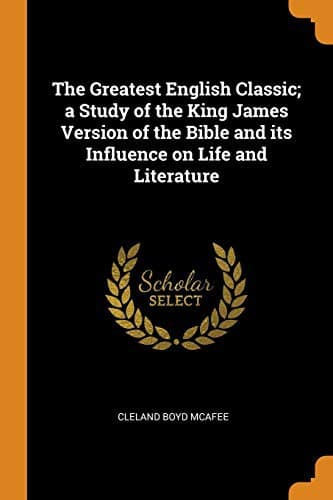
The Greatest English Classic: A Study of the King James Version of the Bible and Its Influence on Life and LiteratureMcAfee, Cleland Boyd
History
The Greatest English Classic: A Study of the King James Version of the Bible and Its Influence on Life and Literature
McAfee, Cleland Boyd
Bible -- History; Bible -- Influence; Bible and literature; Bible. English -- Versions -- Authorized
When this form of criticism has done its part,
and careful study has yielded a text which holds
together and which represents the very best
which scholarship can find for the original, there
is still a field more difficult than that, higher in
the sense that it demands a larger and broader
view of the whole subject. Here one studies
the meaning of the whole, the ideas in it, seeks
to find how the revelation of God has progressed
according to the capacities of men to receive it.
Higher criticism is the careful study of the
historical and original meanings of Scripture, the
effort to determine dates and times and, so far
as may be, the author of each writing, analyzing
its ideas, the general Greek or Hebrew style, the
relation of part to part. That is not a thing to
be afraid of. It is a method of study used in
every realm. It is true that some of the men
who have followed that method have made others
afraid of it, because they were afraid of these
men themselves. It is possible to claim far
too much for such study. But if the result of
higher criticism should be to show that the latter
half of the prophecy of Isaiah is much later than
the earlier half, that is not a destruction of the
Word of God. It is not an irreverent result of
study. If the result of higher criticism is to show
that by reason of its content, and the lessons
which it especially urges, the Epistle to the Hebrews
was not written by the Apostle Paul, as it
does not at any point claim to have been, why,
that is not irreverent, that is not destructive.
There is a destructive form of higher criticism;
against that there is reason to set up bulwarks.
But there is a constructive form of it also.
Scholarly opinion will tell any one who asks
that criticism has not affected the fundamental
values of the Bible. In the studies which have
just now been made we have not instanced anything
in the Bible that is subject to change.
No matter what the result of critical study may
be, the fundamental democracy of the Scripture
remains. It continues to make its persistent
moral appeal on any terms. Both those great
facts continue. Other great facts abide with
them. And on their account it is to our interest
to know as much as we can learn about it. The
Bible has not been lessened in its value, has not
been weakened in itself, by anything that has
taken place in critical study. On the other hand,
the net result of such studies as archaeology has
been the confirmation of much that was once
disputed. Sir William Ramsay is authority for
saying that the spade of the excavator is to-day
digging the grave of many enemies of the Bible.
Public-domain text, read in full here on John Shaqi.
Reviews
Reviews
No reviews yet
Be the first to share your thoughts on this work.
Elsewhere in the archive
Join the Discussion
Join the discussion
Sign in to leave a comment or review.
Sign InorCreate an account