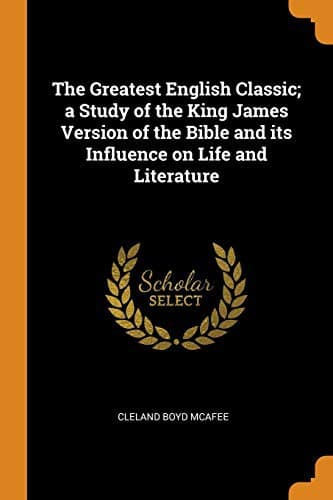
The Greatest English Classic: A Study of the King James Version of the Bible and Its Influence on Life and LiteratureMcAfee, Cleland Boyd
History
The Greatest English Classic: A Study of the King James Version of the Bible and Its Influence on Life and Literature
McAfee, Cleland Boyd
Bible -- History; Bible -- Influence; Bible and literature; Bible. English -- Versions -- Authorized
The third fact which must be taken into account
to explain this remarkable change of
front of the public English life is Henry VIII.
himself. There is much about him that no
country would willingly claim. He was the
most habitual bridegroom in English history;
he had an almost confirmed habit of beheading
his wives or otherwise ridding himself of them.
Yet many traits made him a typical outstanding
Englishman. He had the characteristic spirit of
independence, the resentment of foreign control,
satisfaction with his own land, the feeling
that of course it is the best land. There are no
people in the world so well satisfied with their
own country as the people of England or the
British Isles. They are critical of many things
in their own government until they begin to
compare it with other countries; they must
make their changes on their own lines. The
pamphlet of Henry VIII., which won him the
title of Defender of the Faith, praised the pope;
and, though Sir Thomas More urged him to
change his expressions lest he should live to
regret them, he would not change them. But
that was while the pope was serving his wishes
and what he felt was England's good.
There arose presently the question, or the
several questions, about his marriage. It sheds
no glory on Henry VIII. that they arose as they
did; but his treatment of them must not be
mistaken. He was concerned to have his marriage
to Anne Boleyn confirmed, and there are
some who think he was honest in believing it
ought to be confirmed, though we need not believe
that. What happened was that for the
first time Henry VIII. found that as sovereign
of England he must take commands from a foreign
power, a power exercising temporal sovereignty
exactly as he did, but adding to it a claim
to spiritual power, a claim to determine his conduct
for him and to absolve his people from
loyalty to him if he was not obedient. It arose
over the question of his divorce, but it might
have arisen over anything else. It was limitation
on his sovereignty in England. And he let
it be seen that all questions that pertain to England
were to be settled in England, and not
in another land. He would rather have a matter
settled wrong in England than settled right
elsewhere. That is how he claimed to be
head of the English Church. The people back
of him had always held to the belief that they
were governed from within, though they were
linked to religion from without. He executed
their theory. That assertion of English sovereignty
came during the eventful years of which
we are speaking.
Public-domain text, read in full here on John Shaqi.
Reviews
Reviews
No reviews yet
Be the first to share your thoughts on this work.
Join the Discussion
Join the discussion
Sign in to leave a comment or review.
Sign InorCreate an account