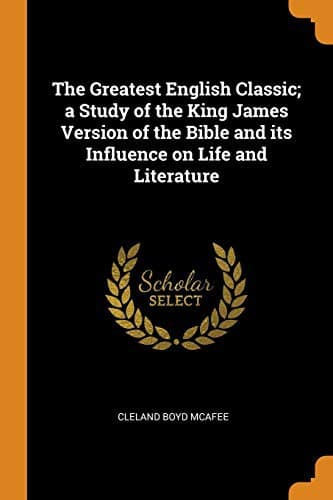
The Greatest English Classic: A Study of the King James Version of the Bible and Its Influence on Life and Literature — John Shaqi
The Greatest English Classic: A Study of the King James Version of the Bible and Its Influence on Life and LiteratureMcAfee, Cleland Boyd
History
The Greatest English Classic: A Study of the King James Version of the Bible and Its Influence on Life and Literature
McAfee, Cleland Boyd
Bible -- History; Bible -- Influence; Bible and literature; Bible. English -- Versions -- Authorized
III. The third marked trait of the work as
a version of the Scripture is its striking blending
of dignity and popularity in its language. At
any period of a living language, there are three
levels of speech. There is an upper level used
by the clearest thinkers and most careful writers,
always correct according to the laws of the language,
generally somewhat remote from common
life--the habitual speech of the more intellectual.
There is also the lower level used by the
least intellectual, frequently incorrect according
to the laws of the language, rough, containing
what we now call "slang," the talk of a knot of
men on the street corner waiting for a new bulletin
of a ball game, cheap in words, impoverished
in synonyms, using one word to express any
number of ideas, as slang always does. Those
two levels are really farther apart than we are
apt to realize. A book or an article on the upper
level will be uninteresting and unintelligible to
the people on the lower level. And a book in
the language of the lower level is offensive and
disgusting to those of the upper level. That is
not because the ideas are so remote, but because
the characteristic expressions are almost unfamiliar
to the people of the different levels.
The more thoughtful people read the abler
journals of the day; they read the editorials or
the more extended articles; they read also the
great literature. If they take up the sporting
page of a newspaper to read the account of a
ball game written in the style of the lower level
of thought, where words are misused in disregard
of the laws of the language, and where one
word is made to do duty for a great many ideas,
they do it solely for amusement. They could
never think of finding their mental stimulus in
that sort of thing. On the other hand, there are
people who find in that kind of reading their
real interest. If they should take up a
thoughtful editorial or a book of essays, they would
not know what the words mean in the connection
in which they are used. They speak a good deal
about the vividness of this lower-level language,
about its popularity; they speak with a sneer
about the stiffness and dignity of that upper
level.
These are, however, only the two extremes,
for there is always a middle level where move
words common to both, where are avoided the
words peculiar to each. It is the language that
most people speak. It is the language of the
street, and also of the study, of the parlor, and
of the shop. But it has little that is peculiar
to either of those other levels, or to any one
place where a man may live his life and do his
talking. If we illustrate from other literature,
we can say that Macaulay's essays move on the
upper level, and that much of the so-called popular
literature of our day moves on the lower
level, while Dickens moves on the middle level,
which means that men whose habitual language
is that of the upper and the lower levels can both
enter into the spirit of his writing.
Public-domain text, read in full here on John Shaqi.
Reviews
Reviews
No reviews yet
Be the first to share your thoughts on this work.
Join the Discussion
Join the discussion
Sign in to leave a comment or review.
Sign InorCreate an account