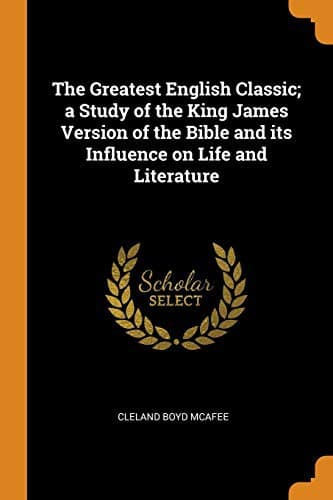
The Greatest English Classic: A Study of the King James Version of the Bible and Its Influence on Life and LiteratureMcAfee, Cleland Boyd
History
The Greatest English Classic: A Study of the King James Version of the Bible and Its Influence on Life and Literature
McAfee, Cleland Boyd
Bible -- History; Bible -- Influence; Bible and literature; Bible. English -- Versions -- Authorized
Now, originally the Bible moved on that middle
level. It was a colloquial book. The languages
in which it first appeared were not in the
classic forms. They are the languages of the
streets where they were written. The Hebrew
is almost our only example of the tongue at its
period, but it is not a literary language in any
case. The Greek of the New Testament is not
the Eolic, the language of the lyrics of Sappho;
nor the Doric, the language of war-songs or the
chorus in the drama; nor the Ionic, the dialect of
epic poetry; but the Attic Greek, and a corrupted
form of that, a form corrupted by use in
the streets and in the markets.
That was the original language of the Bible,
a colloquial language. But that fact does not
determine the translation. Whether it shall be
put into the English language on the upper
level or on the lower level is not so readily
determined. Efforts have been made to put it
into the language of each level. We have a so-
called elegant translation, and we have the
Bible cast into the speech of the common day.
The King James version is on the middle level.
It is a striking blending of the dignity of the
upper level and the popularity of the lower level.
There is tremendous significance in the fact
that these men were making a version which
should be for all people, making it out in the
open day with the king and all the people behind
them. It was the first independent version
which had been made under such favorable
circumstances. Most of the versions had been
made in private by men who were imperiling
themselves in their work. They did not expect
the Book to pass into common use; they knew
that the men who received the result of their
work would have to be those who were earnest
enough to go into secret places for their reading.
But here was a changed condition. These men
were making a version by royal authority, a
version awaited with eager interest by the people
in general. The result is that it is a people's
Book. Its phrases are those of common life,
those that had lived up to that time. It is not
in the peculiar language of the times. If you
want to know the language of their own times,
read these translators' servile, unhistorical dedication to the
king, or their far nobler preface to
the reader. That is the language peculiar to
their own day. But the language of the Bible
itself is that form which had lived its way into
common use. One hundred years after Wiclif
it yet speaks his language in large part, for
that part had really lived. In the Bibliotheca
Pastorum Ruskin makes comment on Sir Philip
Sidney and his metrical version of the Psalms in
these words: "Sir Philip Sidney will use any
cow-boy or tinker words if they only help him
to say precisely in English what David said in
Hebrew; impressed the while himself so vividly
of the majesty of the thought itself that no
tinker's language can lower it or vulgarize it in
his mind." The King James translators were
most eager to say what the original said, and
Public-domain text, read in full here on John Shaqi.
Reviews
Reviews
No reviews yet
Be the first to share your thoughts on this work.
Join the Discussion
Join the discussion
Sign in to leave a comment or review.
Sign InorCreate an account