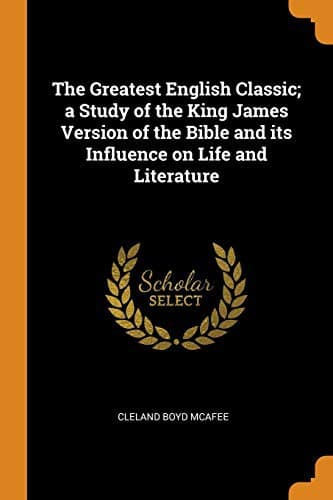
The Greatest English Classic: A Study of the King James Version of the Bible and Its Influence on Life and LiteratureMcAfee, Cleland Boyd
History
The Greatest English Classic: A Study of the King James Version of the Bible and Its Influence on Life and Literature
McAfee, Cleland Boyd
Bible -- History; Bible -- Influence; Bible and literature; Bible. English -- Versions -- Authorized
For seven or eight centuries it held its sway
as the current version nearest to the tongue of
the people. Latin had become the accepted
tongue of the church. There was little general
culture, there was little general acquaintance
with the Bible except among the educated.
During all that time there was no real room for
a further translation. One of the writers[1] says:
"Medieval England was quite unripe for a Bible
in the mother tongue; while the illiterate majority
were in no condition to feel the want of
such a book, the educated minority would be
averse to so great and revolutionary a change."
When a man cannot read any writing it really
does not matter to him whether books are in
current speech or not, and the majority of the
people for those seven or eight centuries could
read nothing at all. Those who could read anything
were apt to be able to read the Latin.
[1] Hoare, Evolution of the English Bible, p. 39.
These centuries added to the conviction of
many that the Bible ought not to become too
common, that it should not be read by everybody,
that it required a certain amount of learning
to make it safe reading. They came to feel
that it is as important to have an authoritative
interpretation of the Bible as to have the Bible
itself. When the movement began to make it
speak the new English tongue, it provoked the
most violent opposition. Latin had been good
enough for a millennium; why cheapen the Bible
by a translation? There had grown up a feeling
that Jerome himself had been inspired. He had
been canonized, and half the references to him
in that time speak of him as the inspired translator.
Criticism of his version was counted as
impious and profane as criticisms of the original
text could possibly have been. It is one of the
ironies of history that the version for which
Jerome had to fight, and which was counted a
piece of impiety itself, actually became the
ground on which men stood when they fought
against another version, counting anything else
but this very version an impious intrusion!
Public-domain text, read in full here on John Shaqi.
Reviews
Reviews
No reviews yet
Be the first to share your thoughts on this work.
Join the Discussion
Join the discussion
Sign in to leave a comment or review.
Sign InorCreate an account