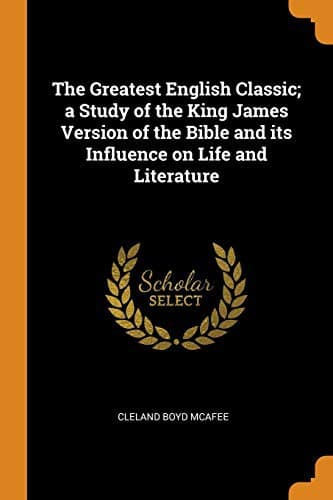
The Greatest English Classic: A Study of the King James Version of the Bible and Its Influence on Life and LiteratureMcAfee, Cleland Boyd
History
The Greatest English Classic: A Study of the King James Version of the Bible and Its Influence on Life and Literature
McAfee, Cleland Boyd
Bible -- History; Bible -- Influence; Bible and literature; Bible. English -- Versions -- Authorized
How early the movement for an English Bible
began, it is impossible now to say. Certainly
just before 700 A.D., that first singer of the English
tongue, Caedmon, had learned to paraphrase
the Bible. We may recall the Venerable Bede's
charming story of him, and how he came by his
power of interpretation. Bede himself was a
child when Caedmon died, and the romance of
the story makes it one of the finest in our literature.
Caedmon was a peasant, a farm laborer
in Northumbria working on the lands of the great
Abbey at Whitby. Already he had passed middle
life, and no spark of genius had flashed in
him. He loved to go to the festive gatherings
and hear the others sing their improvised poems;
but, when the harp came around to him in due
course, he would leave the room, for be could not
sing. One night when he had slipped away
from the group in shame and had made his
rounds of the horses and cattle under his care,
he fell asleep in the stable building, and heard
a voice in his sleep bidding him sing. When he
declared he could not, the voice still bade him
sing. "What shall I sing?" he asked. "Sing
the first beginning of created things." And
the words came to him; and, still dreaming, he
sang his first hymn to the Creator. In the
morning he told his story, and the Lady Abbess
found that he had the divine gift. The monks
had but to translate to him bits of the Bible
out of the Latin, which he did not understand,
into his familiar Anglo-Saxon tongue, and he
would cast it into the rugged Saxon measures
which could be sung by the common people.
So far as we can tell, it was so, that the Bible
story became current in Anglo-Saxon speech.
Bede himself certainly put the Gospel of John
into Anglo-Saxon. At the Bodleian Library, at
Oxford, there is a manuscript of nearly twenty
thousand lines, the metrical version of the
Gospel and the Acts, done near 1250 by an
Augustinian monk named Orm, and so called
the Ormulum. There were other metrical versions
of various parts of the Bible. Midway
between Bede and Orm came Langland's
poem, "The Vision of Piers Plowman,"
which paraphrased so much of the Scripture.
Yet the fact is that until the last quarter of
the fourteenth century there was no prose version
of the Bible in the English language. Indeed,
there was only coming to be an English
language. It was gradually emerging, taking
definite shape and form, so that it could be
distinguished from the earlier Norman French,
Saxon, and Anglo-Saxon, in which so much of
it is rooted.
As soon as the language grew definite enough,
it was inevitable that two things should come
to pass. First, that some men would attempt
to make a colloquial version of the Bible; and,
secondly, that others would oppose it. One can
count with all confidence on these two groups
of men, marching through history like the
animals into the ark, two and two. Some men
propose, others oppose. They are built on
those lines.
Public-domain text, read in full here on John Shaqi.
Reviews
Reviews
No reviews yet
Be the first to share your thoughts on this work.
Join the Discussion
Join the discussion
Sign in to leave a comment or review.
Sign InorCreate an account