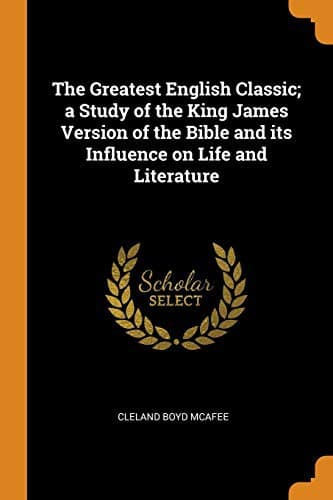
The Greatest English Classic: A Study of the King James Version of the Bible and Its Influence on Life and LiteratureMcAfee, Cleland Boyd
History
The Greatest English Classic: A Study of the King James Version of the Bible and Its Influence on Life and Literature
McAfee, Cleland Boyd
Bible -- History; Bible -- Influence; Bible and literature; Bible. English -- Versions -- Authorized
The first and most notable fact regarding the
influence of the Bible on English literature is
the remarkable extent of that influence. It is
literally everywhere. If every Bible in any
considerable city were destroyed, the Book could
be restored in all its essential parts from the
quotations on the shelves of the city public
library. There are works, covering almost all
the great literary writers, devoted especially to
showing how much the Bible has influenced them.
The literary effect of the King James version
at first was less than its social effect; but in
that very fact lies a striking literary influence.
For a long time it formed virtually the whole
literature which was readily accessible to ordinary
Englishmen. We get our phrases from a
thousand books. The common talk of an intelligent
man shows the effect of many authors
upon his thinking. Our fathers got their phrases
from one great book. Their writing and their
speaking show the effect of that book.
It is a study by itself, and yet it is true that
world literature is, as Professor Moulton puts it,
the autobiography of civilization. "A national
literature is a reflection of the national history."
Books as books reflect their authors. As literature
they reflect the public opinion which gives
them indorsement. When, therefore, public
opinion: keeps alive a certain group of books,
there is testimony not simply to those books,
but to the public opinion which has preserved
them. The history of popular estimates of literature
is itself most interesting. On the other
hand, some writers have been amusingly overestimated.
No doubt Edward Fitzgerald, who gave
us the "Rubaiyat of Omar Khayyam" did
some other desirable work; but Professor Moulton
quotes this paragraph from a popular life of
Fitzgerald, published in Dublin: "Not Greece
of old in her palmiest days--the Greece of Homer
and Demosthenes, of Eschylus, Euripides, and
Sophocles, of Pericles, Leonidas, and Alcibiades,
of Socrates, Plato, and Aristotle, of Solon and
Lycurgus, of Apelles and Praxiteles--not even
this Greece, prolific as she was in sages and
heroes, can boast such a lengthy bead-roll as
Ireland can of names immortal in history!"
But "this was for Irish consumption." And
popular opinion and even critical opinion has
sometimes gone far astray in its destructive
tendency. There were authoritative critics who
declared that Wordsworth, Shelley, and Coleridge
wrote "unintelligible nonsense." George
Meredith's style, especially in his poetry, was
counted so bad that it--was not worth reading.
We are all near enough the Browning epoch to
recall how the obscurity of his style impressed
some and oppressed others. Alfred Austin, in
1869, said that "Mr. Tennyson has no sound
pretensions to be called a great poet."
Contemporary public opinion is seldom a final
gauge of strength for a piece of literature. It
takes the test of time. How many books we
have seen come on the stage and then pass off
Public-domain text, read in full here on John Shaqi.
Reviews
Reviews
No reviews yet
Be the first to share your thoughts on this work.
Elsewhere in the archive
Join the Discussion
Join the discussion
Sign in to leave a comment or review.
Sign InorCreate an account