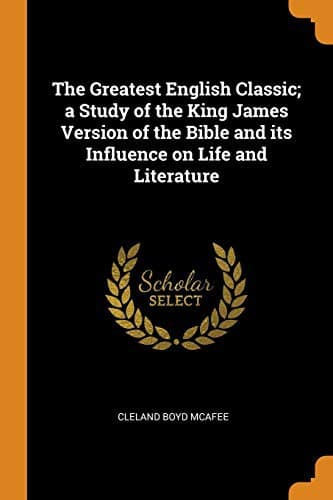
The Greatest English Classic: A Study of the King James Version of the Bible and Its Influence on Life and LiteratureMcAfee, Cleland Boyd
History
The Greatest English Classic: A Study of the King James Version of the Bible and Its Influence on Life and Literature
McAfee, Cleland Boyd
Bible -- History; Bible -- Influence; Bible and literature; Bible. English -- Versions -- Authorized
again! Yet the books that have stayed on the
stage have been kept there by public opinion
expressing itself in the long run. The social
influence of the King James version, creating a
public taste for certain types of literature, tended
to produce them at once.
English literature in these three hundred
years has found in the Bible three influential
elements: style, language, and material.
First, the style of the King James version has
influenced English literature markedly. Professor
Gardiner opens one of his essays with the
dictum that "in all study of English literature,
if there be any one axiom which may be accepted
without question, it is that the ultimate standard
of English prose style is set by the King
James version of the Bible."[1] You almost
measure the strength of writing by its agreement
with the predominant traits of this version.
Carlyle's weakest works are those that
lose the honest simplicity of its style in a forced
turgidity and affected roughness. His Heroes
and Hero Worship or his French Revolution
shows his distinctive style, and yet shows the
influence of this simpler style, while his Frederick
the Great is almost impossible because he has
given full play to his broken and disconnected
sentences. On the other hand, Macaulay fails
us most in his striving for effect, making nice
balance of sentences, straining his "either-or,"
or his "while-one-was-doing-this-the-other-was-
doing-that." Then his sentences grow involved,
and his paragraphs lengthen, and he swings
away from the style of the King James version.
"One can say that if any writing departs very
far from the characteristics of the English Bible
it is not good English writing."
[1] Atlantic Monthly, May, 1900, p. 684.
Public-domain text, read in full here on John Shaqi.
Reviews
Reviews
No reviews yet
Be the first to share your thoughts on this work.
Elsewhere in the archive
Join the Discussion
Join the discussion
Sign in to leave a comment or review.
Sign InorCreate an account