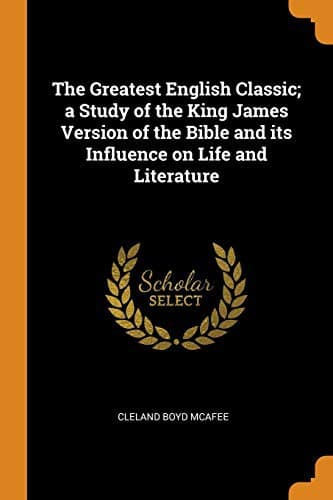
The Greatest English Classic: A Study of the King James Version of the Bible and Its Influence on Life and LiteratureMcAfee, Cleland Boyd
History
The Greatest English Classic: A Study of the King James Version of the Bible and Its Influence on Life and Literature
McAfee, Cleland Boyd
Bible -- History; Bible -- Influence; Bible and literature; Bible. English -- Versions -- Authorized
John Wiclif himself was a scholar of Oxford,
master of that famous Balliol College which
has had such a list of distinguished masters.
He was an adviser of Edward III. Twenty
years after his death a younger contemporary
(W. Thorpe) said that "he was considered by
many to be the most holy of all the men of his
age. He was of emaciated frame, spare, and
well nigh destitute of strength. He was absolutely
blameless in his conduct." And even
that same Knighton who accused him of casting
the Church's pearl before swine says that in
philosophy "he came to be reckoned inferior
to none of his time."
But it was not at Oxford that he came to know
common life so well and to sense the need for
a new social influence. He came nearer to it
when he was rector of the parish at Lutterworth.
As scholar and rector he set going the
two great movements which leave his name in
history. One was his securing, training, and
sending out a band of itinerant preachers or
"poor priests" to gather the people in fields
and byways and to preach the simple truths
of the Christian religion. They were unpaid,
and lived by the kindness of the common people.
They came to be called Lollards, though
the origin of the name is obscure. Their followers
received the same name. A few years
after Wiclif's death an enemy bitterly observed
that if you met any two men one was sure to
be a Lollard. It was the "first time in English
history that an appeal had been made to the
people instead of the scholars." Religion was
to be made rather a matter of practical life than
of dogma or of ritual. The "poor priests" in
their cheap brown robes became a mighty religious
force, and evoked opposition from the
Church powers. A generation after Wiclif's
death they had become a mighty political force
in the controversy between the King and the
Pope. As late as 1521 five hundred Lollards
were arrested in London by the bishop.[1] Wiclif's
purpose, however, was to reach and help the
common people with the simpler, and therefore
the most fundamental, truths of religion.
[1] Muir, Our Grand Old Bible, p. 14.
Public-domain text, read in full here on John Shaqi.
Reviews
Reviews
No reviews yet
Be the first to share your thoughts on this work.
Join the Discussion
Join the discussion
Sign in to leave a comment or review.
Sign InorCreate an account