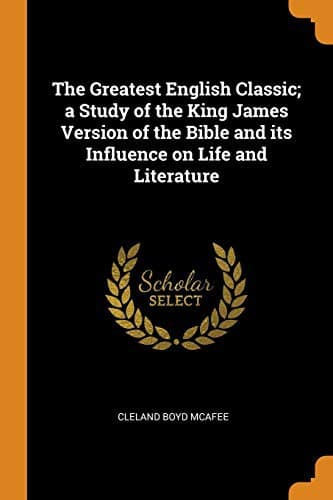
The Greatest English Classic: A Study of the King James Version of the Bible and Its Influence on Life and LiteratureMcAfee, Cleland Boyd
History
The Greatest English Classic: A Study of the King James Version of the Bible and Its Influence on Life and Literature
McAfee, Cleland Boyd
Bible -- History; Bible -- Influence; Bible and literature; Bible. English -- Versions -- Authorized
The other movement which marks Wiclif's
name concerns us more; but it was connected
with the first. He set out to give the common
people the full text of the Bible for their common
use, and to encourage them not only in reading
it, if already they could read, but in learning to
read that they might read it. Tennyson
compares the village of Lutterworth to that of
Bethlehem, on the ground that if Christ, the
Word of God, was born at Bethlehem, the Word
of Life was born again at Lutterworth.[1] The
translation was from the Vulgate, and Wiclif
probably did little of the actual work himself,
yet it is all his work. And in 1382, more than
five centuries ago, there appeared the first complete
English version of the Bible. Wiclif made
it the people's Book, and the English people were
the first of the modern nations to whom the
Bible as a whole was given in their own familiar
tongue. Once it got into their hands they have
never let it be taken entirely away.
[1] "Not least art thou, thou little Bethlehem
In Judah, for in thee the Lord was born;
Nor thou in Britain, little Lutterworth,
Least, for in thee the word was born again."
--Sir John Oldcastle.
Of course, all this was before the days of
printing, and copies were made by hand only.
Yet there were very many of them. One hundred
and fifty manuscripts, in whole or in part,
are extant still, a score of them of the original
version, the others of the revision at once undertaken
by John Purvey, Wiclif's disciple. The
copies belonging to Edward VI. and Queen
Elizabeth are both still in existence, and both
show much use. Twenty years after it was
completed copies were counted very valuable,
though they were very numerous. It was not
uncommon for a single complete manuscript
copy of the Wiclif version to be sold for one
hundred and fifty or two hundred dollars, and
Foxe, whose Book of Martyrs we used to read as
children, tells that a load of hay was given
for the use of a New Testament one hour a day.
Public-domain text, read in full here on John Shaqi.
Reviews
Reviews
No reviews yet
Be the first to share your thoughts on this work.
Join the Discussion
Join the discussion
Sign in to leave a comment or review.
Sign InorCreate an account