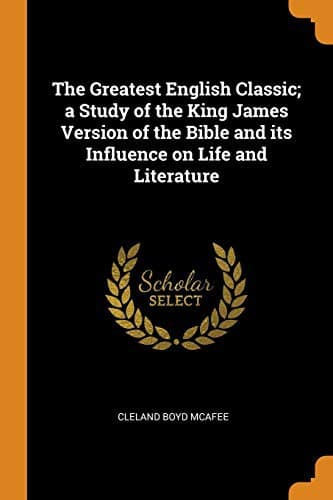
The Greatest English Classic: A Study of the King James Version of the Bible and Its Influence on Life and LiteratureMcAfee, Cleland Boyd
History
The Greatest English Classic: A Study of the King James Version of the Bible and Its Influence on Life and Literature
McAfee, Cleland Boyd
Bible -- History; Bible -- Influence; Bible and literature; Bible. English -- Versions -- Authorized
After these three--Shakespeare, Milton, and
Bunyan--there appeared another three, very
much their inferiors and having much less
influence on literary history. I mean Dryden,
Addison, and Pope. It is not necessary to credit
the Scripture with much of Dryden's spirit, nor
with much of his style, and certainly not with
his attitude toward his fellows; but it is a constant
surprise in reading Dryden to discover
how familiar he was with the King James version.
Walter Scott insists that Dryden was at
heart serious, that "his indelicacy was like the
forced impudence of a bashful man." That is
generous judgment. But there is this to be
said: as he grows more serious he falls more
into Bible words. If he writes a political pamphlet
he calls it "Absalom and Ahithophel."
In it he holds the men of the day up to scorn
under Bible names. They are Zimri and Shimei,
and the like. When he is falling into bitterest
satire, his writing abounds in these Biblical
allusions which could be made only by one who
was very familiar with the Book. Quotations
cannot be abundant, of course, but there is a
great deal of this sort of thing:
"Sinking, he left his drugget robe behind,
Borne upward by a subterranean wind,
The mantle fell to the young prophet's part,
With double portion of his father's art."
In his Epistles there is much of the same sort.
When he writes to Congreve he speaks of the
fathers, and says:
"Their's was the giant race before the flood."
Farther on he says:
"Our builders were with want of genius curst,
The second temple was not like the first."
Now Dryden may have been, as Macaulay said,
an "illustrious renegade," but all his writing
shows the influence of the language and the
ideas of the King James version. Whenever we
sing the "Veni Creator" we sing John Dryden.
So we sing Addison in the paraphrase of
Scripture, which Haydn's music has made
familiar:
"The spacious firmament on high,
With all the blue ethereal sky."
While Dryden yielded to his times, Addison did
not, and the Spectator became not only a literary
but a moral power. In the effort to make it so
he was thrown back on the largest moral influence
of the day, the Bible, and throughout
the Spectator and through all of Addison's
writing you find on all proper occasions the
Bible pressed to the front. Here again Taine
puts it strikingly: "It is no small thing to make
morality fashionable; Addison did it, and it
remains fashionable."
Public-domain text, read in full here on John Shaqi.
Reviews
Reviews
No reviews yet
Be the first to share your thoughts on this work.
Elsewhere in the archive
Join the Discussion
Join the discussion
Sign in to leave a comment or review.
Sign InorCreate an account