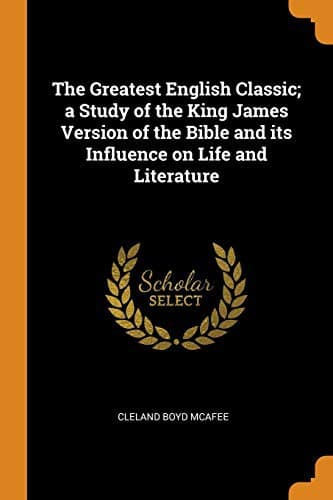
The Greatest English Classic: A Study of the King James Version of the Bible and Its Influence on Life and LiteratureMcAfee, Cleland Boyd
History
The Greatest English Classic: A Study of the King James Version of the Bible and Its Influence on Life and Literature
McAfee, Cleland Boyd
Bible -- History; Bible -- Influence; Bible and literature; Bible. English -- Versions -- Authorized
If we speak of singing, we may remember
that we sing the hymn of even poor little dwarfed
invalid Alexander Pope. He was born the year
Bunyan died, born at cross-purposes with the
world. He could write a bitter satire, like the
"Dunciad"; he could give the world The Iliad
and The Odyssey in such English that we know
them far better than in the Greek of Homer;
but in those rare moments when he was at his
better self he would write his greater poem,
"The Messiah", in which the movement of
Scripture is outlined as it could be only by one
who knew the English Bible. And when we
sing--
"Rise, crowned with light, imperial Salem, rise"--
it is worth while to realize that the voice that
first sung it was that of the irritable little poet
who found some of his scant comfort in the grand
words and phrases and ideas of our English
Bible.
With these six--Shakespeare, Milton, Bunyan,
Dryden, Addison, and Pope--the course of the
Jacobean literature is sufficiently measured.
There are many lesser names, but these are the
ones which made it an epoch in literature, and
these are at their best under the power of the
Bible.
In the Georgian group we need to call only
five great names which have had creative influence
in literature. Ordinary culture in literature
will include some acquaintance with each
of them. In the order of their death they are
Shelley (1829.), Byron (1824), Coleridge (1831),
Walter Scott (1832), and Wordsworth (1850).
The last long outlived the others; but he belongs
with them, because he was born earlier
than any other in the group and did his chief
work in their time and before the later group
appeared. Except Wordsworth, all these were
gone before Queen Victoria came to the throne
in 1837. Three other names could be called:
Keats, Robert Burns, and Charles Lamb. All
would illustrate what we are studying. Keats
least of all and Burns most. They are omitted
here not because they did not feel the influence
of the English Bible, not because they do not
constantly show its influence, but because they
are not so creative as the others; they have not
so influenced the current of literature. At any
rate, the five named will represent worthily and
with sufficient completeness the Georgian period
of English literature.
Public-domain text, read in full here on John Shaqi.
Reviews
Reviews
No reviews yet
Be the first to share your thoughts on this work.
Elsewhere in the archive
Join the Discussion
Join the discussion
Sign in to leave a comment or review.
Sign InorCreate an account