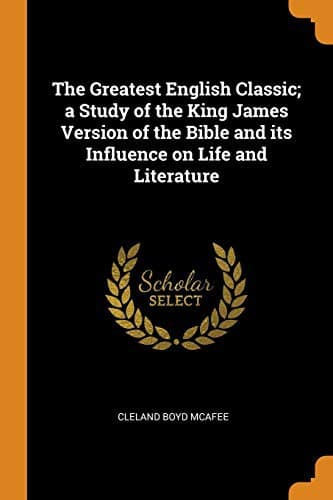
The Greatest English Classic: A Study of the King James Version of the Bible and Its Influence on Life and LiteratureMcAfee, Cleland Boyd
Religion
The Greatest English Classic: A Study of the King James Version of the Bible and Its Influence on Life and Literature
McAfee, Cleland Boyd
Bible -- History; Bible -- Influence; Bible and literature; Bible. English -- Versions -- Authorized
The second fact that helps to explain the sudden change of attitude toward
the Bible is this: the people of England were never willingly ruled from
without, religiously or politically. There has recently been a
considerable controversy over the history of the Established Church of
England, whether it has always been an independent church or was at one
time officially a part of the Roman Church. That is a matter for
ecclesiastical history to determine. The foundation fact, however, is as
I worded it a moment ago: the people of England were never willingly
ruled from without, religiously or politically. They were sometimes ruled
from without; but they were either indifferent to it at the time or
rebellious against it. Those who did think claimed the right to think for
themselves. The Scotch of the north were peculiarly so, but the English of
the south claimed the same right. There has always been an immense
contrast between the two sides of the British Channel. The French people
during all those years were deeply loyal to a foreign religious
government. The English people were never so, not in the days of the
fullest Roman supremacy. They always demanded at least a form of home
government. That made England a congenial home for the Protestant spirit,
which claimed the right to independent study of the sources of religion
and independent judgment regarding them. It was only a continuance of the
spirit of Wiclif and the Lollards. The spirit in a nation lives long,
especially when it is passed down by tradition. Those were not the days of
newspapers. They were instead the days of great meetings, more important
still of small family gatherings, where the memory of the older men was
called into use, and where boys and girls drank in eagerly the traditions
of their own country as expressed in the great events of their history.
Newspapers never can fully take the place of those gatherings, for they do
not bring men together to feel the thrill of the story that is told. It
must be remembered that the entire population of England at that time was
only about three millions. And that old spirit of independence was
strongly at work in the middle-class villages and among the merchants, and
they were a ruling and dominant class. That was second, that in those ten
years there asserted itself the age-long unwillingness of the English
people to be ruled from without.
Public-domain text, read in full here on John Shaqi.
Reviews
Reviews
No reviews yet
Be the first to share your thoughts on this work.
Join the Discussion
Join the discussion
Sign in to leave a comment or review.
Sign InorCreate an account