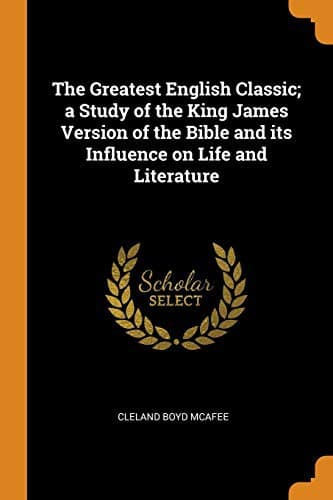
The Greatest English Classic: A Study of the King James Version of the Bible and Its Influence on Life and LiteratureMcAfee, Cleland Boyd
Religion
The Greatest English Classic: A Study of the King James Version of the Bible and Its Influence on Life and Literature
McAfee, Cleland Boyd
Bible -- History; Bible -- Influence; Bible and literature; Bible. English -- Versions -- Authorized
Here, then, are our great facts. First, thoughtful opinion wanted the
Bible made available, and at a convention of bishops and university men
the King was requested to secure the issuance of a proper translation.
Secondly, the people wanted it, the more because it would gratify their
English instinct of independent judgment in matters of religion. Thirdly,
the King granted it without yielding his personal religious position, in
assertion of his human sovereignty within his own realm.
So England awoke one morning in 1537 to discover that it had a translation
of the Bible, two of them actually, open to its use, the very thing that
had been forbidden yesterday! And that, one year after Tindale had been
burned in loyal France for issuing an English translation! Two versions
were now authorized and made available. What were they? That of Miles
Coverdale, which had been issued secretly two years before, and that known
as the "Matthew" Bible, though the name has no significance, issued within
a year. Details are not to our purpose. Neither was an independent work,
but was made largely from the Latin and the German, and much influenced by
Tindale. Coverdale was a Yorkshire man like Wiclif, feminine in his mental
cast as Tindale was masculine. Coverdale made his translation because he
loved books; Tindale because he felt driven to it. But now the way was
clear, and other editions appeared. It is natural to name one or two of
the more notable ones.
There appeared what is known as the Great Bible in 1539. It was only
another version made by Coverdale on the basis of the Matthew version, but
corrected by more accurate knowledge. There is an interesting romance of
its publication. The presses of England were not adequate for the great
work planned; it was to be a marvel of typography. So the consent of King
Francis was gained to have it printed in France, and Coverdale was sent
as a special ambassador to oversee it. He was in dread of the Inquisition,
which was in vogue at the time, and sent off his printed sheets to England
as rapidly as possible. Suddenly one day the order of confiscation came
from the Inquisitor-General. Only Coverdale's official position as
representing the King saved his own life. As for the printed sheets on
which so much depended, they seemed doomed. But in the nick of time a
dealer appeared at the printing-house and purchased four great vats full
of waste paper which he shipped to England--when it was found that the
waste paper was those printed sheets. The presses and the printers were
all loyal to England, and the edition was finally completed. The Great
Bible was issued to meet a decree that each church should make available
in some convenient place the largest possible copy of the whole Bible,
where all the parishioners could have access to it and read it at their
will. The version gets its name solely from the size of the volume. That
decree dates 1538, twelve years after Tindale's books were burned, and two
Public-domain text, read in full here on John Shaqi.
Reviews
Reviews
No reviews yet
Be the first to share your thoughts on this work.
Join the Discussion
Join the discussion
Sign in to leave a comment or review.
Sign InorCreate an account