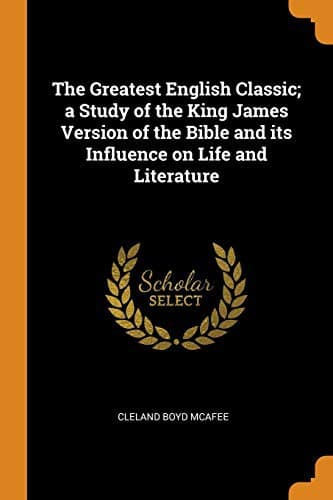
The Greatest English Classic: A Study of the King James Version of the Bible and Its Influence on Life and LiteratureMcAfee, Cleland Boyd
Religion
The Greatest English Classic: A Study of the King James Version of the Bible and Its Influence on Life and Literature
McAfee, Cleland Boyd
Bible -- History; Bible -- Influence; Bible and literature; Bible. English -- Versions -- Authorized
Elizabeth herself was not an ardent Protestant, not ardent at all
religiously, but an ardent Englishwoman. She understood her people, and
while she prided herself on being the "Guardian of the Middle Way," she
did not make the mistake of submitting her sovereignty to foreign
supervision. Probably Elizabeth always counted herself personally a
Catholic, but not politically subject to the Roman pontiff. She had no
wish to offend other Catholic powers; but she was determined to develop a
strong national spirit and to allow religious differences to exist if they
would be peaceful. The dramatic scene which was enacted at the time of
her coronation procession was typical of her spirit. As the procession
passed down Cheapside, a venerable old man, representing Time, with a
little child beside him representing Truth--Time always old, Truth always
young--presented the Queen with a copy of the Scriptures, which she
accepted, promising to read them diligently.
Presently it was found that two versions of the Bible were taking the
field, the old Great Bible and the new Genevan Bible. On all accounts the
Genevan was the better and was driving out its rival. Yet there could be
no hope of gaining the approval of Elizabeth for the Genevan Bible. For
one thing, John Knox had been a party to its preparation; so had Calvin.
Elizabeth detested them both, especially Knox. For another thing, its
notes were not favorable to royal sovereignty, but smacked so much of
popular government as to be offensive. For another thing, though it had
been made mostly by her own people, it had been made in a foreign land,
and was under suspicion on that account. The result was that Elizabeth's
archbishop, Parker, set out to have an authorized version made, selected a
revision committee, with instructions to follow wherever possible the
Great Bible, to avoid bitter notes, and to make such a version that it
might be freely, easily, and naturally read. The result is known as the
Bishops' Bible. It was issued in Elizabeth's tenth year (1568), but there
is no record that she ever noticed it, though Parker sent her a copy from
his sick-bed. The Bishops' Bible shows the influence of the Genevan Bible
in many ways, though it gives no credit for that. It is not of equal
merit; it was expensive, too cumbersome, and often unscholarly. Only its
official standing gave it life, and after forty years, in nineteen
editions, it was no longer published.
Public-domain text, read in full here on John Shaqi.
Reviews
Reviews
No reviews yet
Be the first to share your thoughts on this work.
Join the Discussion
Join the discussion
Sign in to leave a comment or review.
Sign InorCreate an account