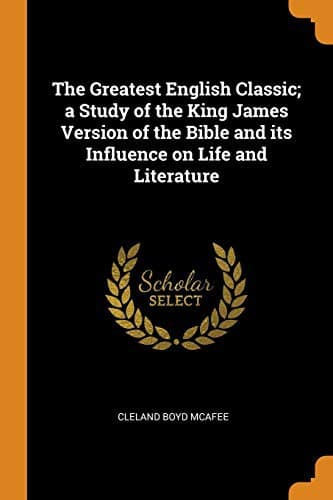
The Greatest English Classic: A Study of the King James Version of the Bible and Its Influence on Life and LiteratureMcAfee, Cleland Boyd
Religion
The Greatest English Classic: A Study of the King James Version of the Bible and Its Influence on Life and Literature
McAfee, Cleland Boyd
Bible -- History; Bible -- Influence; Bible and literature; Bible. English -- Versions -- Authorized
Naming one other English version will complete the series of facts
necessary for the consideration of the forming of the King James version.
It will be remembered that all the English versions of the Bible thus far
mentioned were the work of men either already out of favor with the Roman
pontiff, or speedily put out of favor on that account. Thirty years after
his death, Wiclif's bones were taken up and burned; Tindale was burned.
Coverdale's version and the Great Bible were the product of the period
when Henry VIII. was under the ban. The Genevan Bible was the work of
refugees, and the Bishops' Bible was prepared when Elizabeth had been
excommunicated. That fact seemed to many loyal Roman churchmen to put the
Church in a false light. It must be made clear that its opposition was not
to the Bible, not even to popular use and possession of the Bible, but
only to unauthorized, even incorrect, versions. So there came about the
Douai version, instigated by Gregory Martin, and prepared in some sense as
an answer to the Genevan version and its strongly anti-papal notes. It was
the work of English scholars connected with the University of Douai. The
New Testament was issued at Rheims in 1582, and the whole Bible in 1609,
just before our King James version. It is made, not from the Hebrew and
the Greek, though it refers to both, but from the Vulgate. The result is
that the Old Testament of the Douai version is a translation into English
from the Latin, which in large part is a translation into Latin from the
Greek Septuagint, which in turn is a translation into Greek from the
Hebrew. Yet scholars are scholars, and it shows marked influence of the
Genevan version, and, indeed, of other English versions. Its notes were
strongly anti-Protestant, and in its preface it explains its existence by
saying that Protestants have been guilty of "casting the holy to dogs and
pearls to hogs."
The version is not in the direct line of the ascent of the familiar
version, and needs no elaborate description. Its purpose was
controversial; it did not go to available sources; its English was not
colloquial, but ecclesiastical. For example, in the Lord's Prayer we read:
"Give us this day our supersubstantial bread," instead of "our daily
bread." In Hebrews xiii:17, the version reads, "Obey your prelates and be
subject unto them." In Luke iii:3, John came "preaching the baptism of
penance." In Psalm xxiii:5, where we read, "My cup runneth over," the
Douai version reads, "My chalice which inebriateth me, how goodly it is."
There is a careful retention of ecclesiastical terms, and an explanation
of the passages on which Protestants had come to differ rather sharply
from their Roman brethren, as in the matter of the taking of the cup by
the people, and elsewhere.
Public-domain text, read in full here on John Shaqi.
Reviews
Reviews
No reviews yet
Be the first to share your thoughts on this work.
Join the Discussion
Join the discussion
Sign in to leave a comment or review.
Sign InorCreate an account