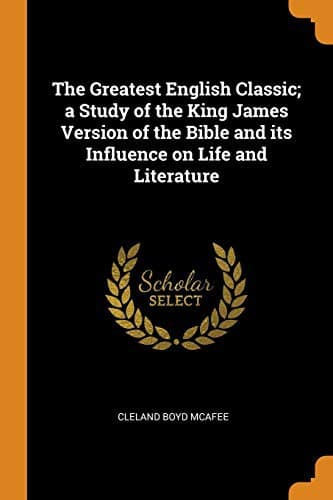
The Greatest English Classic: A Study of the King James Version of the Bible and Its Influence on Life and LiteratureMcAfee, Cleland Boyd
Religion
The Greatest English Classic: A Study of the King James Version of the Bible and Its Influence on Life and Literature
McAfee, Cleland Boyd
Bible -- History; Bible -- Influence; Bible and literature; Bible. English -- Versions -- Authorized
Early in January, 1604, men were making their way along the poor English
highways, by coach and carrier, to the Hampton Court Palace of the new
English king. They were coming from the cathedral towns, from the
universities, from the larger cities. Many were Church dignitaries, many
were scholars, some were Puritans, all were loyal Englishmen, and they
were gathering in response to a call for a conference with the king, James
I. They were divided in sentiment, these men, and those who hoped most
from the conference were doomed to complete disappointment. Not one among
them, not the King, had the slightest purpose that the conference should
do what proved to be its only real service. Some of the men, grave and
earnest, were coming to present their petitions to the King, others were
coming to oppose their petitions; the King meant to deny them and to
harry the petitioners. And everything came out as it had been planned. Yet
the largest service of the conference, the only real service, was in no
one's mind, for it was at Hampton Court, on the last day of the conference
between James and the churchmen, January 18, 1604, that the first formal
step was taken toward the making of the so-called Authorized Version of
the English Bible. If there are such things as accidents, this great
enterprise began in an accident. But the outcome of the accident, the
volume that resulted, is "allowed by all competent authorities to be the
first [that is, the chief] English classic," if our Professor Cook, of
Yale, may speak; "is universally accepted as a literary masterpiece, as
the noblest and most beautiful Book in the world, which has exercised an
incalculable influence upon religion, upon manners, upon literature, and
upon character," if the Balliol College scholar Hoare can be trusted; and
has "made the English language," if Professor March is right. The purpose
of this study is to show how that accident occurred, and what immediately
came from it.
* * * * *
Public-domain text, read in full here on John Shaqi.
Reviews
Reviews
No reviews yet
Be the first to share your thoughts on this work.
Join the Discussion
Join the discussion
Sign in to leave a comment or review.
Sign InorCreate an account