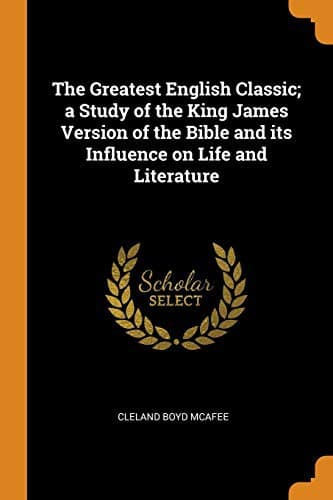
The Greatest English Classic: A Study of the King James Version of the Bible and Its Influence on Life and Literature — John Shaqi
The Greatest English Classic: A Study of the King James Version of the Bible and Its Influence on Life and LiteratureMcAfee, Cleland Boyd
Religion
The Greatest English Classic: A Study of the King James Version of the Bible and Its Influence on Life and Literature
McAfee, Cleland Boyd
Bible -- History; Bible -- Influence; Bible and literature; Bible. English -- Versions -- Authorized
It was the original plan that when one company had finished its part, the
result should go to each of the other companies, coming back with their
suggestions to the original workers to be recast by them. The whole was
then to be reviewed by a smaller committee of scholars to give it
uniformity and to see it through the press. The records are not extant
that tell whether this was done in full detail, though we may presume that
each section of the Scripture had the benefit of the scholarship of the
entire company.
We know a good deal of the method of their work. We shall understand it
better by recalling what material they had at hand. They were enabled to
use the result of all the work that had been done before them. They were
instructed to follow the Bishops' Bible wherever they could do so fairly;
but they were given power to use the versions already named from Wiclif
down, as well as those fragmentary versions which were numerous, and of
which no mention has been made. They ransacked all English forms for
felicitous words and happy phrases. It is one of the interesting incidents
that this same Hugh Broughton, who was left off the committee and took it
so hard, yet without his will contributed some important matter to the
translation, because he had on his own authority made translations of
certain parts of the Scripture. Several of our capital phrases in the King
James version are from him. There was no effort to break out new paths.
Preference was always given to a familiar phrase rather than to a new one,
unless accuracy required it. First, then, they had the benefit of all the
work that had been done before in the same line, and gladly used it.
In addition, they had all other versions made in the tongues of the time.
Chiefly there was Luther's German Bible, already become for the German
tongue what their version was destined to be for the English tongue. There
were parts of the Bible available in Spanish, French, and Dutch. They were
kept at hand constantly for any light they might cast on difficult
passages.
For the Old Testament there were very few Hebrew texts. There had been
little critical work yet done on them, and for the most part there were
only different editions running back over the centuries. We have little
more than that now, and there is almost no new material on the Old
Testament since the days of the King James translators. There was, of
course, the Septuagint, the Greek translation from the Hebrew made before
Christ, with the guidance it could give in doubtful places on the probable
original. And finally there was the Vulgate, made into Latin out of the
Greek and Hebrew. This was all the Old Testament material they had, or
that any one could have in view of the antiquated original sources.
Public-domain text, read in full here on John Shaqi.
Reviews
Reviews
No reviews yet
Be the first to share your thoughts on this work.
Join the Discussion
Join the discussion
Sign in to leave a comment or review.
Sign InorCreate an account