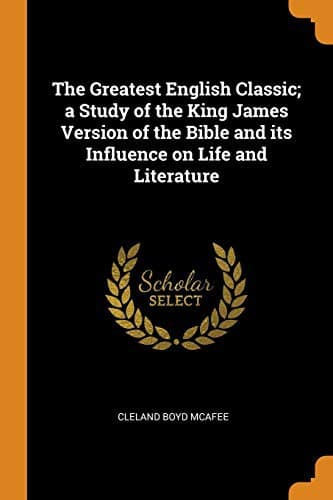
The Greatest English Classic: A Study of the King James Version of the Bible and Its Influence on Life and LiteratureMcAfee, Cleland Boyd
Religion
The Greatest English Classic: A Study of the King James Version of the Bible and Its Influence on Life and Literature
McAfee, Cleland Boyd
Bible -- History; Bible -- Influence; Bible and literature; Bible. English -- Versions -- Authorized
I. Name this first, that it is an honest version. That is, it has no
argumentative purpose. It is not, as the scholars say, apologetic. It is
simply an out-and-out version of the Scripture, as honestly as they could
reproduce it. There were Puritans on the committee; there were extreme
High Churchmen; there were men of all grades between. But there is nowhere
any evidence that any one was set on making the Bible prove his point.
There were strong anti-papal believers among them; but they made free use
of the Douai version, and, of course, of the Vulgate. They knew the
feeling that Hugh Broughton had toward them; but they made generous use of
all that was good in his work. They were working under a royal warrant,
and their dedication to King James, with its absurd and fulsome flattery,
shows what they were capable of when they thought of the King. But there
is no twist of a text to make it serve the purposes of royalty. They might
be servile when they thought of King James; but there was not a touch of
servility in them when they thought of the Scripture itself. They were
under instruction not to abandon the use of ecclesiastical terms. For
instance, they were not to put "congregation" in place of "church," as
some Puritans wanted to do. Some thought that was meant to insure a High
Church version; but the translators did not understand it so for a moment.
They understood it only to safeguard them against making a partisan
version on either side, and to help them to make a version which the
people could read understandingly at once. It was not to be a Puritan Book
nor a High Church Book. It was to be an honest version of the Bible, no
matter whose side it sustained.
Now, if any one thinks that is easy, or only a matter of course, he
plainly shows that he has never been a theologian or a scholar in a
contested field. Ask any lawyer whether it is easy to handle his
authorities with entire impartiality, whether it is a matter of course
that he will let them say just what they meant to say when his case is
involved. Of course, he will seek to do it as an honest lawyer, but
equally, of course, he will have to keep close watch on himself or he will
fail in doing it. Ask any historian whether it is easy to handle the
original documents in a field in which he has firm and announced
opinions, and to let those documents speak exactly what they mean to say,
whether they support him or not. The greater historians will always do it,
but they will sometimes do it with a bit of a wrench.
Public-domain text, read in full here on John Shaqi.
Reviews
Reviews
No reviews yet
Be the first to share your thoughts on this work.
Join the Discussion
Join the discussion
Sign in to leave a comment or review.
Sign InorCreate an account