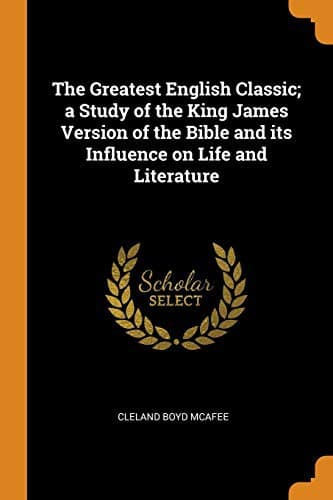
The Greatest English Classic: A Study of the King James Version of the Bible and Its Influence on Life and LiteratureMcAfee, Cleland Boyd
Religion
The Greatest English Classic: A Study of the King James Version of the Bible and Its Influence on Life and Literature
McAfee, Cleland Boyd
Bible -- History; Bible -- Influence; Bible and literature; Bible. English -- Versions -- Authorized
We need not seek more instances. These are enough to illustrate the saying
that here is an honest version, the fruit of the best scholarship of the
times, without prejudice.
II. A second trait of the work as a version is its remarkable accuracy. It
is surprising that with all the new light coming from early documents,
with all the new discoveries that have been made, the latest revision
needed to make so few changes, and those for the most part minor ones.
There are, to be sure, some important changes, as we shall see later; the
wonder is that there are not many more. The King James version had, to be
sure, the benefit of all the earlier controversy. The whole ground had
been really fought over in the centuries before, and most of the questions
had been discussed. They frankly made use of all the earlier controversy.
They say in their preface: "Truly, good Christian reader, we never thought
from the beginning that we should need to make a new translation, nor yet
to make a bad one a good one, but to make a good one better. That hath
been our endeavor, that our work." Also, they had the advantage of
deliberation. This was the first version that had been made which had such
sanction that they could take their time, and in which they had no reason
to fear that the results would endanger them. They say in their preface
that they had not run over their work with that "posting haste" that had
marked the Septuagint, if the saying was true that they did it all in
seventy-two days; nor were they "barred and hindered from going over it
again," as Jerome himself said he had been, since as soon as he wrote any
part "it was snatched away from him and published"; nor were they
"working in a new field," as Origen was when he wrote his first
commentary on the Bible. Both these things--their taking advantage of
earlier controversies which had cleared many differences, and their
deliberation--were supplemented by a third which gave great accuracy to
the version. That was their adoption of the principle of all early
translators, perhaps worded best by Purvey, who completed the Wiclif
version: "The best translation is to translate after the sentence, and not
only after the words, so that the sentence be as open in English as in
Latin." That makes for accuracy. It is quite impossible to put any
language over, word for word, into another without great inaccuracy. But
when the translators sought to take the sentence of the Hebrew or the
Greek and put it into an exactly equivalent English sentence, they had
larger play for their language and they had a fairer field for accuracy.
These were the three great facts which made the remarkable accuracy
possible, and it may be interesting to note three corresponding results
which show the effort they made to be absolutely accurate and fair in
their translation.
Public-domain text, read in full here on John Shaqi.
Reviews
Reviews
No reviews yet
Be the first to share your thoughts on this work.
Join the Discussion
Join the discussion
Sign in to leave a comment or review.
Sign InorCreate an account