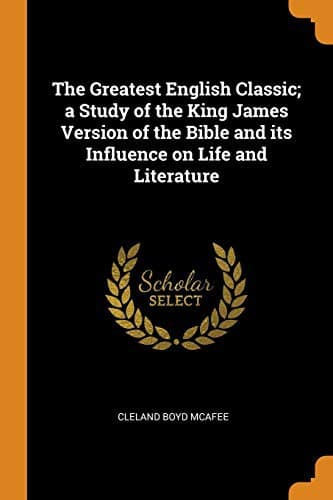
The Greatest English Classic: A Study of the King James Version of the Bible and Its Influence on Life and Literature — John Shaqi
The Greatest English Classic: A Study of the King James Version of the Bible and Its Influence on Life and LiteratureMcAfee, Cleland Boyd
Religion
The Greatest English Classic: A Study of the King James Version of the Bible and Its Influence on Life and Literature
McAfee, Cleland Boyd
Bible -- History; Bible -- Influence; Bible and literature; Bible. English -- Versions -- Authorized
But two strong impulses drive thoughtful men to any effort that will
secure wide knowledge of the Bible. One is their love of the Bible and
their belief in it; but the other, dominant then and now, is a sense of
the need of their own time. It cannot be too strongly urged that the two
great pioneers of English Bible translation, Wiclif and Tindale, more than
a century apart, were chiefly moved to their work by social conditions. No
one could read the literature of the times of which we are speaking
without smiling at our assumption that we are the first who have cared for
social needs. We talk about the past as the age of the individual, and the
present as the social age. Our fathers, we say, cared only to be saved
themselves, and had no concern for the evils of society. They believed in
rescuing one here and another there, while we have come to see the wisdom
of correcting the conditions that ruin men, and so saving men in the mass.
There must be some basis of truth for that, since we say it so
confidently; but it can be much over-accented. There were many of our
fathers, and of our grandfathers, who were mightily concerned with the
mass of people, and looked as carefully as we do for a corrective of
social evils. Wiclif, in the late fourteenth century, and Tindale, in the
early sixteenth, were two such men. The first English translations of the
Bible were fruits of the social impulse.
Wiclif was impressed with the chasm that was growing between the church
and the people, and felt that a wider and fuller knowledge of the Bible
would be helpful for the closing of the chasm. It is a familiar remark of
Miss Jane Addams that the cure for the evils of democracy is more
democracy. Wiclif believed that the cure for the evils of religion is more
religion, more intelligent religion. He found a considerable feeling that
the best things in religion ought to be kept from most people, since they
could not be trusted to understand them. His own feeling was that the best
things in religion are exactly the things most people ought to know most
about; that people had better handle the Bible carelessly, mistakenly,
than be shut out from it by any means whatever. We owe the first English
translation to a faith that the Bible is a book of emancipation for the
mind and for the political life.
John Wiclif himself was a scholar of Oxford, master of that famous Balliol
College which has had such a list of distinguished masters. He was an
adviser of Edward III. Twenty years after his death a younger contemporary
(W. Thorpe) said that "he was considered by many to be the most holy of
all the men of his age. He was of emaciated frame, spare, and well nigh
destitute of strength. He was absolutely blameless in his conduct." And
even that same Knighton who accused him of casting the Church's pearl
before swine says that in philosophy "he came to be reckoned inferior to
none of his time."
Public-domain text, read in full here on John Shaqi.
Reviews
Reviews
No reviews yet
Be the first to share your thoughts on this work.
Join the Discussion
Join the discussion
Sign in to leave a comment or review.
Sign InorCreate an account