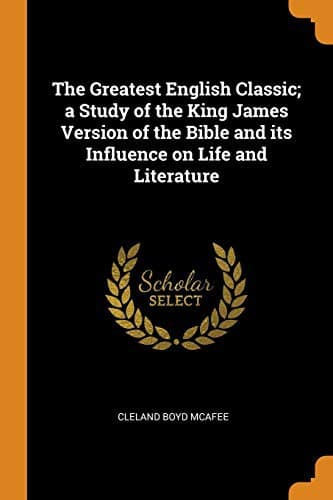
The Greatest English Classic: A Study of the King James Version of the Bible and Its Influence on Life and LiteratureMcAfee, Cleland Boyd
Religion
The Greatest English Classic: A Study of the King James Version of the Bible and Its Influence on Life and Literature
McAfee, Cleland Boyd
Bible -- History; Bible -- Influence; Bible and literature; Bible. English -- Versions -- Authorized
But it was not at Oxford that he came to know common life so well and to
sense the need for a new social influence. He came nearer to it when he
was rector of the parish at Lutterworth. As scholar and rector he set
going the two great movements which leave his name in history. One was his
securing, training, and sending out a band of itinerant preachers or "poor
priests" to gather the people in fields and byways and to preach the
simple truths of the Christian religion. They were unpaid, and lived by
the kindness of the common people. They came to be called Lollards,
though the origin of the name is obscure. Their followers received the
same name. A few years after Wiclif's death an enemy bitterly observed
that if you met any two men one was sure to be a Lollard. It was the
"first time in English history that an appeal had been made to the people
instead of the scholars." Religion was to be made rather a matter of
practical life than of dogma or of ritual. The "poor priests" in their
cheap brown robes became a mighty religious force, and evoked opposition
from the Church powers. A generation after Wiclif's death they had become
a mighty political force in the controversy between the King and the Pope.
As late as 1521 five hundred Lollards were arrested in London by the
bishop.[2] Wiclif's purpose, however, was to reach and help the common
people with the simpler, and therefore the most fundamental, truths of
religion.
The other movement which marks Wiclif's name concerns us more; but it was
connected with the first. He set out to give the common people the full
text of the Bible for their common use, and to encourage them not only in
reading it, if already they could read, but in learning to read that they
might read it. Tennyson compares the village of Lutterworth to that of
Bethlehem, on the ground that if Christ, the Word of God, was born at
Bethlehem, the Word of Life was born again at Lutterworth.[3] The
translation was from the Vulgate, and Wiclif probably did little of the
actual work himself, yet it is all his work. And in 1382, more than five
centuries ago, there appeared the first complete English version of the
Bible. Wiclif made it the people's Book, and the English people were the
first of the modern nations to whom the Bible as a whole was given in
their own familiar tongue. Once it got into their hands they have never
let it be taken entirely away.
Public-domain text, read in full here on John Shaqi.
Reviews
Reviews
No reviews yet
Be the first to share your thoughts on this work.
Join the Discussion
Join the discussion
Sign in to leave a comment or review.
Sign InorCreate an account