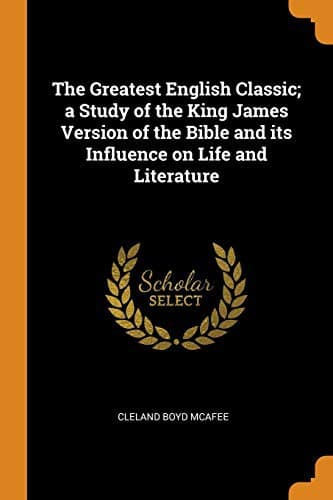
The Greatest English Classic: A Study of the King James Version of the Bible and Its Influence on Life and LiteratureMcAfee, Cleland Boyd
Religion
The Greatest English Classic: A Study of the King James Version of the Bible and Its Influence on Life and Literature
McAfee, Cleland Boyd
Bible -- History; Bible -- Influence; Bible and literature; Bible. English -- Versions -- Authorized
Another thing to be said is that America has a unique history among great
nations in that it has never been affected by any great religious
influence except that which has issued from the Scriptures. No religion
has ever been influential in America except Christianity. For many years
there have been sporadic and spasmodic efforts to extend the influence of
Buddhism or other Indian cults. They have never been successful, because
the American spirit is practical, and not meditative. We are not an
introspective people. We do not look within ourselves for our religion.
Whatever moral and religious influence our literature shows gets back
first or last to our Scriptures. The point of view of nature that is taken
by our writers like Bryant and Thoreau is that of the Nineteenth Psalm.
Moreover, we have been strongly under the English influence. Irving
insisted that we ought to be, that we were a young nation, that we ought
frankly to follow the leadership of more experienced writers. Longfellow
thought we had gone too far that way, and that our poets, at least, ought
to be more independent, ought to write in the spirit of America and not of
traditional poetry. Whether we ought to have yielded to it or not, it is
true that English influence has told very strongly upon us, and the
writers who have influenced our writers most have been those whom we have
named as being themselves under the Bible influence.
We need not go into detail about these writers, though they are most
attractive. Bryant did for us what Wordsworth did for England. He made
nature seem vocal. "Thanatopsis" is not a Christian poem in the narrow
sense of the word, and yet it could hardly have been written except under
Christian influence. His own genial, beautiful character was itself a
tribute to Christian civilization, and his life, as critic and essayist,
has left an impression which we shall not soon lose. Professor Richardson
thinks that the three problematical characters in American literature are
Emerson, Hawthorne, and Poe. The shrewdest estimate of Poe that has ever
been given us is in Lowell's _Fable for Critics_:
"There comes Poe with his raven like Barnaby Rudge,
Three-fifths of him genius, and two-fifths sheer fudge,
Who has written some things quite the best of their kind,
But the heart somehow seems all squeezed out by the mind."
That says it exactly. Poe knew many horrible situations, but he did not
know the way out; and of all our American writers laying claim to place in
the first class Poe shows least influence of the Bible, and apparently
needs it most.
Public-domain text, read in full here on John Shaqi.
Reviews
Reviews
No reviews yet
Be the first to share your thoughts on this work.
Elsewhere in the archive
Join the Discussion
Join the discussion
Sign in to leave a comment or review.
Sign InorCreate an account