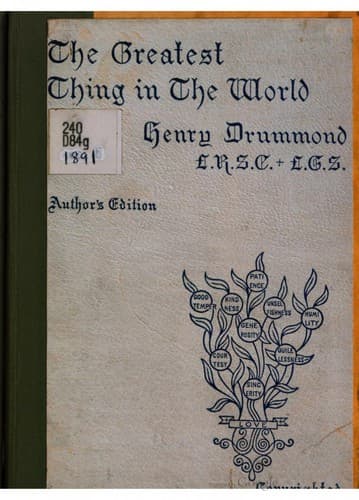
The Greatest Thing In the World and Other AddressesDrummond, Henry
ReligionComparative
The Greatest Thing In the World and Other Addresses
Drummond, Henry
Christian life; Christianity; Love -- Religious aspects
Edward Irving went to see a dying boy once, and when he entered the
room he just put his hand on the sufferer's head, and said, "My boy,
God loves you," and went away. The boy started from his bed, and
called out to the people in the house,
"God loves me! God loves me!"
One word! It changed that boy. The sense that God loved him
overpowered him, melted him down, and began the creating of a new
heart in him. And that is how the love of God melts down the unlovely
heart in man, and begets in him the new creature, who is patient and
humble and gentle and unselfish. And there is no other way to get it.
There is no mystery about it. We love others, we love everybody, we
love our enemies, _because He first loved us_.
III. THE DEFENCE.
Now I have a closing sentence or two to add about Paul's reason for
singling out love as the supreme possession.
It is a very remarkable reason. In a single word it is this: _it
lasts._ "Love," urges Paul, "never faileth." Then he begins again one
of his marvelous lists of the great things of the day, and exposes
them one by one. He runs over the things that men thought were going
to last, and shows that they are all fleeting, temporary, passing
away.
"Whether there be _prophecies_, they shall be done away." It was the
mother's ambition for her boy in those days that he should become a
prophet. For hundreds of years God had never spoken by means of any
prophet, and at that time the prophet was greater than the king. Men
waited wistfully for another messenger to come, and hung upon his lips
when he appeared, as upon the very voice of God. Paul says, "Whether
there be prophecies, they shall fail." The Bible is full of
prophecies. One by one they have "failed"; that is, having been
fulfilled, their work is finished; they have nothing more to do now in
the world except to feed a devout man's faith.
Then Paul talks about _tongues_. That was another thing that was
greatly coveted. "Whether there be tongues, they shall cease." As we
all know, many many centuries have passed since tongues have been
known in this world. They have ceased. Take it in any sense you like.
Take it, for illustration merely, as languages in general--a sense
which was not in Paul's mind at all, and which though it cannot give
us the specific lesson, will point the general truth. Consider the
words in which these chapters were written--Greek. It has gone. Take
the Latin--the other great tongue of those days. It ceased long ago.
Look at the Indian language. It is ceasing. The language of Wales, of
Ireland, of the Scottish Highlands is dying before our eyes. The most
popular book in the English tongue at the present time, except the
Bible, is one of Dickens' works, his _Pickwick Papers_. It is largely
written in the language of London street-life; and experts assure us
that in fifty years it will be unintelligible to the average English
reader.
Public-domain text, read in full here on John Shaqi.
Reviews
Reviews
No reviews yet
Be the first to share your thoughts on this work.
Join the Discussion
Join the discussion
Sign in to leave a comment or review.
Sign InorCreate an account