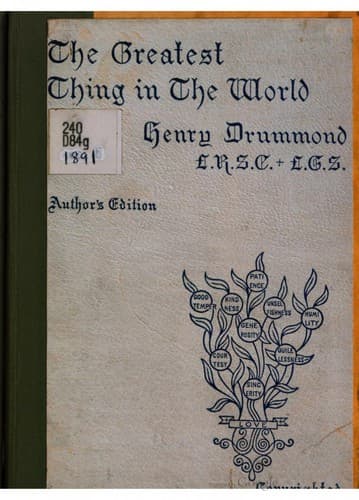
The Greatest Thing In the World and Other AddressesDrummond, Henry
ReligionComparative
The Greatest Thing In the World and Other Addresses
Drummond, Henry
Christian life; Christianity; Love -- Religious aspects
Then Paul goes farther, and with even greater boldness adds, "Whether
there be _knowledge_, it shall be done away." The wisdom of the
ancients, where is it? It is wholly gone. A schoolboy to-day knows
more than Sir Isaac Newton knew; his knowledge has vanished away. You
put yesterday's newspaper in the fire: its knowledge has vanished
away. You buy the old editions of the great encyclopaedias for a few
cents: their knowledge has vanished away. Look how the coach has been
superseded by the use of steam. Look how electricity has superseded
that, and swept a hundred almost new inventions into oblivion. One of
the greatest living authorities, Sir William Thompson, said in
Scotland, at a meeting at which I was present, "The steam-engine is
passing away." "Whether there be knowledge, it shall vanish away." At
every workshop you will see, in the back yard, a heap of old iron, a
few wheels, a few levers, a few cranks, broken and eaten with rust.
Twenty years ago that was the pride of the city. Men flocked in from
the country to see the great invention; now it is superseded, its day
is done. And all the boasted science and philosophy of this day will
soon be old.
In my time, in the university of Edinburgh, the greatest figure in the
faculty was Sir James Simpson, the discoverer of chloroform. Recently
his successor and nephew, Professor Simpson, was asked by the
librarian of the University to go to the library and pick out the
books on his subject (midwifery) that were no longer needed. His reply
to the librarian was this:
"Take every text-book that is more than ten years old and put it down
in the cellar."
Sir James Simpson was a great authority only a few years ago: men came
from all parts of the earth to consult him; and almost the whole
teaching of that time is consigned by the science of to-day to
oblivion. And in every branch of science it is the same. "Now we know
in part. We see through a glass darkly." Knowledge does not last.
Can you tell me anything that is going to last? Many things Paul did
not condescend to name. He did not mention money, fortune, fame; but
he picked out the great things of his time, the things the best men
thought had something in them, and brushed them peremptorily aside.
Paul had no charge against these things in themselves. All he said
about them was that they would not last. They were great things, but
not supreme things. There were things beyond them. What we are
stretches past what we do, beyond what we possess. Many things that
men denounce as sins are not sins; but they are temporary. And that is
a favorite argument of the New Testament. John says of the world, not
that it is wrong, but simply that it "passeth away." There is a great
deal in the world that is delightful and beautiful; there is a great
deal in it that is great and engrossing; but
IT WILL NOT LAST.
Public-domain text, read in full here on John Shaqi.
Reviews
Reviews
No reviews yet
Be the first to share your thoughts on this work.
Join the Discussion
Join the discussion
Sign in to leave a comment or review.
Sign InorCreate an account