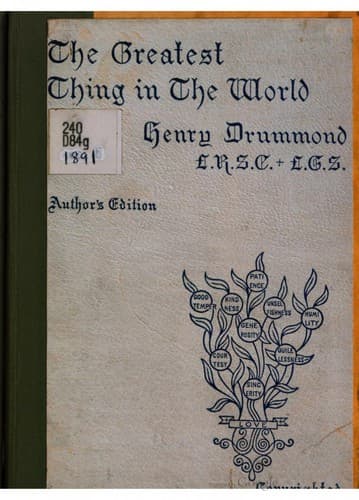
The Greatest Thing In the World and Other AddressesDrummond, Henry
ReligionComparative
The Greatest Thing In the World and Other Addresses
Drummond, Henry
Christian life; Christianity; Love -- Religious aspects
Such living, as mere living, is altogether unique. It is only when we
see what it was in Him that we can know what the word Rest means. It
lies not in emotions, or in the absence of emotions. It is not a
hallowed feeling that comes over us in church. It is not something
that the preacher has in his voice. It is not in nature, or in poetry,
or in music--though in all these there is soothing. It is the mind at
leisure from itself. It is the perfect poise of the soul; the absolute
adjustment of the inward man to the stress of all outward things; the
preparedness against every emergency; the stability of assured
convictions; the eternal calm of an invulnerable faith; the repose of
a heart set deep in God. It is the mood of the man who says, with
Browning, "God's in His Heaven, all's well with the world."
Two painters each painted a picture to illustrate his conception of
rest. The first chose for his scene a still, lone lake among the
far-off mountains. The second threw on his canvas a thundering
waterfall, with a fragile birch-tree bending over the foam; at the
fork of a branch, almost wet with the cataract's spray, a robin sat on
its nest. The first was only _Stagnation_; the last was _Rest_. For in
Rest there are always two elements--tranquillity and energy; silence
and turbulence; creation and destruction; fearlessness and
fearfulness. This it was in Christ.
It is quite plain from all this that whatever else He claimed to be or
to do, He at least
KNEW HOW TO LIVE.
All this is the perfection of living, of living in the mere sense of
passing through the world in the best way. Hence His anxiety to
communicate His idea of life to others. He came, He said, to give men
life, true life, a more abundant life than they were living; "the
life," as the fine phase in the Revised Version has it, "that is life
indeed." This is what He Himself possessed, and it was this which He
offers to mankind. And hence His direct appeal for all to come to Him
who had not made much of life, who were weary and heavy-laden. These
He would teach His secret. They, also, should know "the life that is
life indeed."
II. WHAT YOKES ARE FOR.
There is still one doubt to clear up. After the statement, "Learn of
Me," Christ throws in the disconcerting qualification:
"_Take my yoke_ upon you, and learn of Me."
Why, if all this be true, does He call it a _yoke_? Why, while
professing to give Rest, does He with the next breath whisper
"_burden_"? Is the Christian life, after all, what its enemies take it
for--an additional weight to the already great woe of life, some
extra punctiliousness about duty, some painful devotion to
observances, some heavy restriction and trammeling of all that is
joyous and free in the world? Is life not hard and sorrowful enough
without being fettered with yet another yoke?
Public-domain text, read in full here on John Shaqi.
Reviews
Reviews
No reviews yet
Be the first to share your thoughts on this work.
Join the Discussion
Join the discussion
Sign in to leave a comment or review.
Sign InorCreate an account