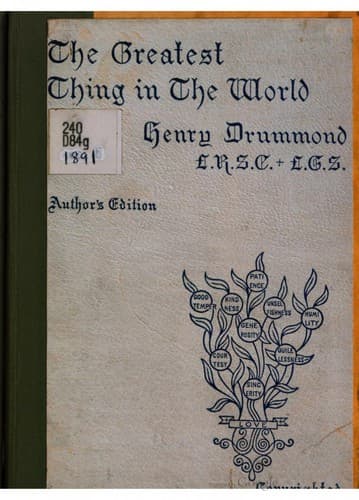
The Greatest Thing In the World and Other Addresses — John Shaqi
The Greatest Thing In the World and Other AddressesDrummond, Henry
ReligionComparative
The Greatest Thing In the World and Other Addresses
Drummond, Henry
Christian life; Christianity; Love -- Religious aspects
It is astounding how so glaring a misunderstanding of this plain
sentence should ever have passed into currency. Did you ever stop to
ask what a yoke is really for? Is it to be a burden to the animal
which wears it? It is just the opposite. It is to make its burden
light. Attached to the oxen in any other way than by a yoke, the
plough would be intolerable. Worked by means of a yoke, it is light. A
yoke is not an instrument of torture; it is
AN INSTRUMENT OF MERCY.
It is not a malicious contrivance for making work hard; it is a gentle
device to make hard labor light. It is not meant to give pain, but to
save pain. And yet men speak of the yoke of Christ as if it were
slavery, and look upon those who wear it as objects of compassion. For
generations we have had homilies on "The Yoke of Christ"--some
delighting in portraying its narrow exactions; some seeking in these
exactions the marks of its divinity; others apologizing for it, and
toning it down; still others assuring us that, although it be very
bad, it is not to be compared with the positive blessings of
Christianity. How many, especially among the young, has this one
mistaken phrase driven forever away from the kingdom of God? Instead
of making Christ attractive, it makes Him out a taskmaster, narrowing
life by petty restrictions, calling for self-denial where none is
necessary, making misery a virtue under the plea that it is the yoke
of Christ, and happiness criminal because it now and then evades it.
According to this conception, Christians are at best the victims of a
depressing fate; their life is a penance; and their hope for the next
world purchased by a slow martyrdom in this.
The mistake has arisen from taking the word "yoke" here in the same
sense as in the expressions "under the yoke," or "wear the yoke in his
youth." But in Christ's illustration it is not the _jugum_ of the
Roman soldier, but the simple "harness" or "ox-collar" of the Eastern
peasant. It is the literal wooden yoke which He, with His own hands in
the carpenter shop, had probably often made. He knew the difference
between a smooth yoke and a rough one, a bad fit and a good fit; the
difference also it made to the patient animal which had to wear it.
The rough yoke galled, and the burden was heavy; the smooth yoke
caused no pain, and the load was lightly drawn. The badly fitted
harness was a misery; the well-fitted collar was "easy."
Public-domain text, read in full here on John Shaqi.
Reviews
Reviews
No reviews yet
Be the first to share your thoughts on this work.
Join the Discussion
Join the discussion
Sign in to leave a comment or review.
Sign InorCreate an account