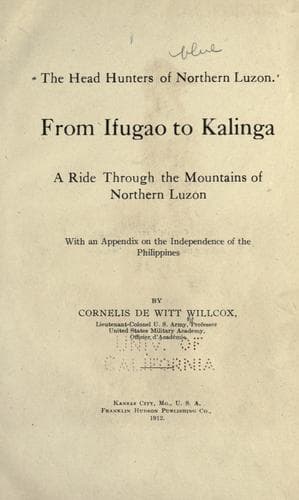
The Head Hunters of Northern LuzonWillcox, Cornélis De Witt
History
The Head Hunters of Northern Luzon
Willcox, Cornélis De Witt
Igorot (Philippine people); Luzon (Philippines) -- Description and travel
So we did honor to the occasion,
but had to let out our belts before mounting immediately afterward.
CHAPTER III
Padre Juan Villaverde.--His great trail.--The beginning of
the mountain journey.--Nozo.
The point to which we had come, San Francisco, marks the beginning of
the Juan Villaverde trail from the Central Valley of Luzon through
the mountains before us, to the province of Nueva Vizcaya. All day
the chain we were to pierce had been in sight, and I for one had been
wondering where we were to find a practicable entrance, so forbiddingly
vertical did the range appear to be.
Now the Spaniards in the Philippines at best were but poor road-
or trail-makers. Indeed, in the matter of trails they were simply
stupid, in some cases actually going straight up a hill and down
the other side, when the way around was no longer, and of course far
easier to maintain. But Padre Juan Villaverde of the Dominicans was
a great and honorable exception. Quite apart from this aspect, we
hear so much that is evil of the friars that it is a pleasure, when
possible, to point out the good they did, a thing more frequently
possible than people imagine it is. For Father Villaverde gave his
life to missionary work among the hill-people, seeking in every way to
better their condition materially as well as morally. Born in 1841,
as early as 1868 we find him on duty at Bayombong, in Nueva Vizcaya,
the province we were about to enter. From the first he seems to have
been impressed by the possibilities of the country in which he was
laboring; and, foreseeing that good communications would ultimately
settle most of the questions relating to the highlanders, he built
trails, trails that are still in use, whereas nearly all the others
(but few in number) established by the Spaniards have been abandoned by
us, where Nature has not indeed saved us the trouble by washing them
out of existence. For thirty years Villaverde worked unceasingly,
building roads and bridges and churches, and striving to civilize
the people among whom he lived; but his chief work, that by which
his memory is kept green to this day, is the great trail from the
otherwise almost inaccessible province of Nueva Vizcaya, across the
Caraballos to the Central Valley of Luzon, where access to the outer
world by rail becomes possible. This trail is officially designated
by his name, and is maintained by Government. This was the one we
were about to enter upon. [10] Accordingly we thanked our kind hosts
of San Francisco; and at last set out on our real trip. But, curious
and eager as I felt to engage upon it, I could not help regretting that
this part of our journey was over, that we had to turn our backs on the
smiling plains of Pangasinán, its hospitable and courteous people. The
day had been so cool and fresh, and our progress so easy; flat as
was the country, it had its charm, the charm of cultivated plains,
relieved by lanes of feathered bamboos, by clumps of nodding palms,
by limpid streams.
Public-domain text, read in full here on John Shaqi.
Reviews
Reviews
No reviews yet
Be the first to share your thoughts on this work.
Join the Discussion
Join the discussion
Sign in to leave a comment or review.
Sign InorCreate an account