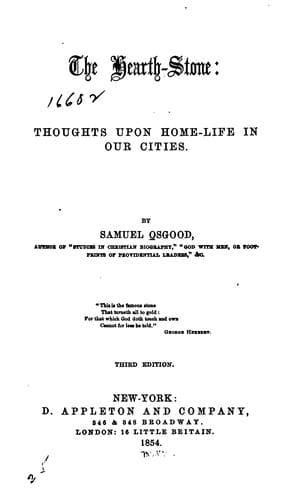
The Hearth-Stone: Thoughts Upon Home-Life in Our CitiesOsgood, Samuel
Religion
The Hearth-Stone: Thoughts Upon Home-Life in Our Cities
Osgood, Samuel
Christian life; Conduct of life
Mark the change in the feelings of the son. In a short time what a
transition in the lot of this reckless roaming boy. His dream of fortune
and pleasure has been most rudely broken, and the spendthrift is the
penniless outcast. A season of famine, or what in our more commercial age
would be called hard times, came on, and the pressure that bears upon all
drives him to the very verge of starvation. Where are the gay mansions now
that opened their doors so eagerly to the young stranger, so lavish with
his wealth? Where are the boon companions that borrowed his money, and
rode his horses, and drunk his wine? Where such friends are very likely to
be in time of need; ready to cut the acquaintance of the wretch upon whose
prosperity they have fattened and fawned. He is in a sad plight, and might
have been driven to some desperate crime--to murder or to suicide, did he
not learn one of the blessed lessons of God's Providence, and use misery
as a stern, yet judicious schoolmaster, to lead him to remorse and
penitence.
Suffering wakens him from his vain dream, and he sees things now as they
are,--takes upon his shoulders the burden of his griefs,--confesses that
he has abused the very generosity of his father, and is no longer worthy
to be called his son. Remorse, no proof of depravity past redemption, but
proof rather that conscience still lives, and is vindicating her holy law,
exalted the poor outcast, even in humbling him to the dust, and lifts the
wretch into the penitent, with those words, "I will arise, and go to my
father."
This penitence crowns the new experience of the prodigal, and brings him
into a new sphere of thought and action. He feels the power of a love that
he had slighted, and which now pleads with his soul in an eloquence all
the mightier from its tone of expostulation and pity. His childhood
reappears to him in all its innocence and privilege,--the old homestead,
with its familiar walls and trees, haunts him not as a dream, but as the
one reality, and seems to eye his wretchedness with wonder and compassion.
He is a changed man now, and turns his face upon the long journey
homeward, not merely as an outcast hungry and miserable, but as a penitent
seeking forgiveness of the kindness which he had outraged, and asking to
do a servant's work on the estate whose income he had wasted.
Public-domain text, read in full here on John Shaqi.
Reviews
Reviews
No reviews yet
Be the first to share your thoughts on this work.
Elsewhere in the archive
Join the Discussion
Join the discussion
Sign in to leave a comment or review.
Sign InorCreate an account