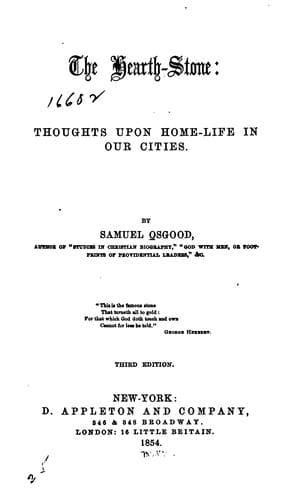
The Hearth-Stone: Thoughts Upon Home-Life in Our CitiesOsgood, Samuel
Religion
The Hearth-Stone: Thoughts Upon Home-Life in Our Cities
Osgood, Samuel
Christian life; Conduct of life
At home or abroad this tempter may come, and in forms as many as are the
shapes of folly and sin. The son may not have erred simply in desiring to
go from home to seek his fortunes. He may have intended to use his portion
of the inheritance in a more profitable way than at home, and perhaps
return to the quiet old farm-house, rich in treasure and experience, a
benefactor to the whole family. Youth is full of dreams, and of not
ignoble dreams, and of the thousands of young men who every month go out
into the world to seek their fortune, few, if any, mean to throw their
hopes away in dissipation. Young blood is ever sanguine, and fair indeed
would this earth be, if it could take the hue and shape of the youthful
visions that have brooded upon its future. The very fact that a man hopes
much, may throw him into a despair as intense as his hope, and the
sanguine dreamer may degenerate under disappointment into the reckless
prodigal. The portion of the inheritance which was to swell into
affluence, being broken by some mischance, seems good for nothing but a
brief round of pleasure, and is squandered in riotous living. Or the
wanderer may start with the idea that expensive habits will secure to him
friends and position, until he finds that these habits are his masters,
and these friends go away when his money is gone. Let any sober-minded man
who has consistently tried to use well his means and opportunity, remember
the perils that have lurked in his own path, and he will make some due
allowance for the temptations that now beset young men. We are not called
to lower in the least our standard of virtue, but we are to enlarge our
views to measure the extent of the danger, and to relax our severity to
win the erring to repentance and amendment. Make the ease our own, and as
we look upon the many forms of youthful vice and folly around us, see our
own youth thus come back to us, and read the sad lessons as so many
chapters in the book of our own possible destiny. Such considerations,
instead of making us more lax in principle, will make us more strict, by
making us feel more deeply the curse of that transgression, which we thus
bring home to our own thoughts. Combine all the various sources of
temptation, bear in mind the portions that may come severally from the
youth, his guardians and the world, and it will not appear proof of utter
depravity that there should be some prodigals on earth.
* * * * *
The emphasis of the parable turns not upon the fall, but upon the recovery
of the erring one, and the portraiture of the various steps in the
recovery is so drawn to the life, as to answer with due change of manners
and costume for any age. Mark its progress, in the mind of the youth and
the parent, and in the final reconciliation of the two.
Public-domain text, read in full here on John Shaqi.
Reviews
Reviews
No reviews yet
Be the first to share your thoughts on this work.
Elsewhere in the archive
Join the Discussion
Join the discussion
Sign in to leave a comment or review.
Sign InorCreate an account