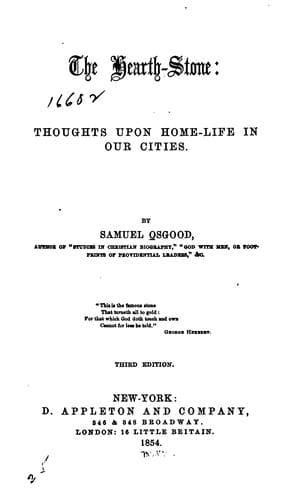
The Hearth-Stone: Thoughts Upon Home-Life in Our Cities — John Shaqi
The Hearth-Stone: Thoughts Upon Home-Life in Our CitiesOsgood, Samuel
Religion
The Hearth-Stone: Thoughts Upon Home-Life in Our Cities
Osgood, Samuel
Christian life; Conduct of life
Herein lies a great element of power and of hope for our country. Our soil
is rich, our lakes and rivers are vast, our strength is great, our courage
good, our schools are many, our wealth is unexampled. But these are not
all--nor are these the elements that are to tame our barbaric borders, and
lead to harmony our chaotic and scattered members. The church and home
must go together, and unite our nation under the empire of Christ, as
under the empire of civil law. The church and home are advancing together
from the Atlantic to the Pacific shore. The farmer of Oregon, the miner of
California, are not to be beyond the pale of Christian civilization. Even
they shall hear the chimes that tell of the nativity of the Saviour--they
shall find in their homes, rude cabins though they may be, pleasant faces,
whose womanly grace and childish confidence shall reveal a light kindled
of old by the Blessed Mother, and nurtured for ever by her Holy Child.
Here patriotism and Christianity blend in one. Anathema upon the false
speculations and foul vices that assault the family institution. Blessed
be the gospel of Him who asserts the uncompromising law of domestic
purity, and opens most tenderly the Divine benignity, when most urging the
Divine commandment.
* * * * *
There is a branch of this subject which I cannot treat--one, perhaps, that
dwells too much in the region of higher sentiment to be the theme of
popular discussion, and which no writer can easily handle, without seeming
to be borrowing from the ancient theology its comments on the Song of
Songs, or delving in the dark but rich mines of Swedenborg's Arcana. Yet
it would be no far-fetched topic, whilst speaking of her who has been
called the Queen of Heaven, and regarded by the Fenelons and Catharines of
faith, as the type of celestial loveliness, to treat of the ideal of
womanhood in the spiritual world. Surely the higher a true culture rises,
the more clearly each great family of souls becomes more true to its own
genius, and the higher companionship known on earth, in the most refined
society, and the worthiest families, illustrates the permanence of those
traits that give man and woman their intellectual and moral
characteristics. The earthly loves, which Christ came to consecrate, bear
the germs of immortal uses, and are like Mary's own emblem the rose,
which, though born in the earth, lifts its bloom and wafts its fragrance
to the heavens. I know no more elevated illustration of this view than
that given by the Milton of Italy, the solemn Dante, who, in his vision of
Heaven, wanders through the celestial courts with the spirit that had been
the charm of his earthly life, and who, often as he stood confounded
before some new mystery, found his perplexities solved by the readier
intuition of his sainted companion. The higher companionship in
literature, art, society, religion, which we enjoy in this world, and
Public-domain text, read in full here on John Shaqi.
Reviews
Reviews
No reviews yet
Be the first to share your thoughts on this work.
Join the Discussion
Join the discussion
Sign in to leave a comment or review.
Sign InorCreate an account