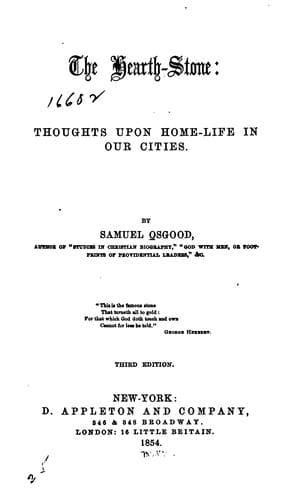
The Hearth-Stone: Thoughts Upon Home-Life in Our CitiesOsgood, Samuel
Religion
The Hearth-Stone: Thoughts Upon Home-Life in Our Cities
Osgood, Samuel
Christian life; Conduct of life
which is so incomplete when men or women are alone, gives some idea of the
state of souls on high, where they that shine most, and they that love
most, cherubim and seraphim, blend their holy ministries and bow together
before the Eternal Presence.
A homelier view of the subject must end our meditation--a view, however,
that opens into the heavenly world. The homelier the better--the nearer to
our hearts. Let us call Mary blessed to-day for ourselves, and for our own
families and friends. Bless her, now that we are thinking of all good
mothers, whether the queen true to her children on her island-throne, or
the faithful mother in the farmer's cottage;--so many on the earth--so
many who have gone from the world, and whose remembered faces now bring
heaven near. Bless her now, that we are thinking of the happy children
gathered together in the name of her Holy Child--as we think of the hosts
of little children whom He has called and is calling to Himself. It is a
time to be sober, and a time to be merry. In our soberness and our mirth,
alike let us remember God's love for us in Jesus Christ our Lord.
God's blessing, readers, upon you all--mothers, fathers, children,
brothers, sisters, friends--meeting or to meet in the sanctuary, or in
your homes! His love bring all together at last around the tree of life,
whose fruit is peace eternal!
_Christmas Eve._
The Hope of Childhood.
THE HOPE OF CHILDHOOD.
The account of the Flight to Egypt, so illustrated by the old masters,
brings three images before us, all in themselves interesting, and
expressive of lasting realities. Central, is the figure of a young child,
speaking at once of childhood and the God who blesses it. On either side
what contrast in the associated forms! On one hand stands Mary, watching
with unwearied vigils over her precious charge. In the distance, in his
stately palace, the dark form of the tyrant king rises before us; his
hands stained with the blood of a noble wife and three sons, his
conscience torn by remorse, his wrath the more inflamed from the
consciousness of deserving vengeance, his despotic will brooking no
thought of rivalry, and dooming to death the infant innocents of a whole
town to make sure of destroying the predicted Messiah.
Here is an emblem of what is over in the world. Here is childhood, its
guardian angel, and its evil genius. May not the scene suggest some
thoughts upon Christianity as the guardian of childhood against the spirit
of the world, which is its foe?
Public-domain text, read in full here on John Shaqi.
Reviews
Reviews
No reviews yet
Be the first to share your thoughts on this work.
Join the Discussion
Join the discussion
Sign in to leave a comment or review.
Sign InorCreate an account