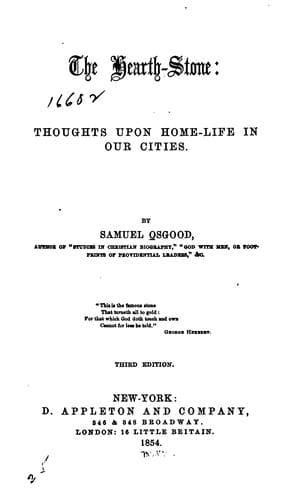
The Hearth-Stone: Thoughts Upon Home-Life in Our CitiesOsgood, Samuel
Religion
The Hearth-Stone: Thoughts Upon Home-Life in Our Cities
Osgood, Samuel
Christian life; Conduct of life
In the primitive time the Christian confessors showed how fondly they had
been taught to regard their offspring, to care for their souls in life and
in death, to commend them with deathless love to Him who had opened the
gates of everlasting life. In the Roman catacombs, far beneath the city,
the places of early Christian worship and burial, the inscriptions on the
tombstones well express the parental feelings of that time. An uncommonly
large portion of the epitaphs given in the description belong to
children, and they express the tenderest affection. "Virginius remained
but a short time with us." "Sweet Faustina, may you live in God."
"Laurence to his sweetest son, Severus, borne away by angels on the
seventh Ides of January." How different the spirit breathed in such
inscriptions from that inspired by the idolatry, that formed a god of the
war-spirit that makes childhood desolate and orphaned, or bows down before
Moloch and casts children into the fire at his feet!
Turn even to those ages that are called by eminence dark--the time of
monkish austerity and priestly sway. There is much in their annals to move
indignation and sometimes horror. But interpret them fairly, and we find
much to move our admiration and love. Consider that embodiment of the
middle ages, the Gothic cathedral, wonderful alike for the vastness of its
proportions and the delicacy of its details. There may be austerity in the
priests that attend its altars, fanaticism in the monks who chant its
litanies, cruelty in the mailed men who kneel at its chancel. But how
tender is the expression of the whole in reference to childhood! The Holy
Mother and her Divine child beam upon the worshipper from illuminated
missals and painted windows. Conspicuous at the vestibule or by the altar,
stands the baptismal font. Thither the child of the poorest peasant is
brought, and by the baptismal water the child is recognized as belonging
to the kingdom not of this world, a lamb of the good Shepherd. Not for the
few rich, noble or mighty, but even for him, the least of the earth, this
temple was erected, and by that rite the church, imperial in its stately
palace, promises to watch over the child, care for his soul in sorrow,
sickness and death. What would childhood have been in the dark ages
without the Church? What other power could have stood between innocence
and its tempter and destroyer? Who would have withstood Herod, if the
mother heart of Christianity had withheld its guardianship?
Public-domain text, read in full here on John Shaqi.
Reviews
Reviews
No reviews yet
Be the first to share your thoughts on this work.
Join the Discussion
Join the discussion
Sign in to leave a comment or review.
Sign InorCreate an account