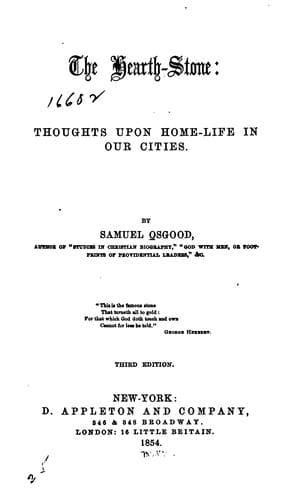
The Hearth-Stone: Thoughts Upon Home-Life in Our CitiesOsgood, Samuel
Religion
The Hearth-Stone: Thoughts Upon Home-Life in Our Cities
Osgood, Samuel
Christian life; Conduct of life
The mother and child fled to Egypt, there to languish or be forgotten?
Herod sat in his palace hall, there to rule and prosper? No. Ere the year
closed, he died; before death came, already a mass of putrefaction. He
died, signing with his fainting hands his will and the death-warrant of
his oldest son; thus dispensing death and empire in his last act. He died,
and the magnificence of his funeral mocked the wretchedness of his
decease. The body was borne aloft on a bier, which was adorned with gems;
the winding-sheet was of purple; his whole army, native and foreign,
marched in war array to his grave. As the gorgeous procession by slow
stages passed to the stately mausoleum, twenty-five miles distant at the
Herodium, word went to the fugitives in Egypt, that the tyrant was dead.
Who at that time, in the excitement of the funeral, or the festivities of
the succession--who cared for the obscure family, that stole on its way
quietly to Nazareth? The mother and child lived! They founded a kingdom
that dies never.
Richly that Christ-child repaid his mother's watching, alike to her and to
her sex. The religion of Christ has been the strength and comfort of
parents, and the hope of their children. Its power in the nurture of the
young mind has been illustrated in every age, and connects itself now
momentously with the most important topics of our time. What topic more
congenial with this Christmas season, so consecrated to associations with
childhood and youth, leading us back to the cradle of the infant Redeemer,
and opening a festival in which young hearts all over the world rejoice?
The child ever needs protection; Herod ever in some form rages;
Christianity like a mighty maternal heart needs ever to keep its watch.
* * * * *
Look upon the past history of Christendom from this point of view, and how
novel and interesting is the result! We have been taught to associate the
progress of Christianity with the account of theological controversies,
bitter disputes, bloody persecutions, proud hierarchies; and thus we too
often read the annals of the Church with shame or contempt. But take a
fairer and more intimate view: think of Christianity in connection with
childhood and youth, trace its influence upon the home, the school, the
Church, in this aspect. Do this, and we shall find ourselves moved by the
annals of every age to tenderness and gratitude; for in every age
Christianity has been the guardian of childhood against the spirit of the
world, its foe. When the Saviour took young children in his arms and
blessed them, he performed an act which has not been without significance
in all subsequent time.
Public-domain text, read in full here on John Shaqi.
Reviews
Reviews
No reviews yet
Be the first to share your thoughts on this work.
Join the Discussion
Join the discussion
Sign in to leave a comment or review.
Sign InorCreate an account