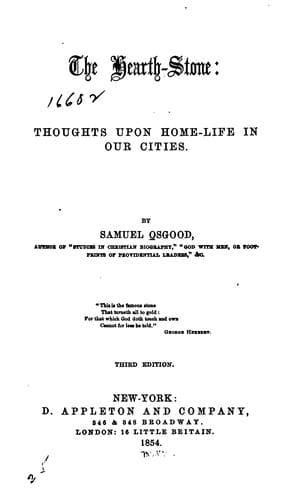
The Hearth-Stone: Thoughts Upon Home-Life in Our CitiesOsgood, Samuel
Religion
The Hearth-Stone: Thoughts Upon Home-Life in Our Cities
Osgood, Samuel
Christian life; Conduct of life
The most obvious, certainly the most obtrusive evil in the homes of the
wretched, is poverty. The love of God, who has given for man's use the
earth and its fulness, the gospel of Him who fed the hungry and healed the
sick, teach us to look with tender interest upon the poor, and try to
redeem them from a lot as full of temptation as of suffering. Of public
and private almsgiving, I will not speak now, important in their places as
these are. There is a need far greater than these can alleviate, and I
cannot dwell upon them here, pertinent as it would be to urge the worth of
those benevolent schemes that aim to provide comfortable homes for the
poor, and commodious baths and wash-houses in their neighborhoods. These
charities appeal to enlightened self-interest, as well as humanity, and,
if we will not ask in kindness who is my neighbor, we shall ask in fear,
either of pestilent disease or aggressive violence. The springs of human
energy are to be moved as never before, and the wretched are to be made to
help themselves as never before; or our civilization, certainly European
civilization, will stand on the brink of an abyss fearful as at the
dissolution of the old Roman Empire. Poverty has, in some cases, made an
alliance that gives omens of a conspiracy worse than Catiline's, and, with
cunning quickened by want, sharpens its knife upon the stone which has
fallen to its lot instead of bread,--bent upon living by destruction, if
it is not taught to live by producing. It is an indisputable fact that in
many countries the majority are so ignorant and inefficient, that the
whole annual product of the land is not sufficient to provide for their
decent wants. The theorists of France, who have been losing their wits in
the airy heights of pantheistic socialism, hoping to find a way to plenty,
other than the old way of labor and frugality, may well remember the
answer of the admirable political economist, Chevalier, and look for
plenty rather in making property more desirable than less so, and giving
the whole people the desire and the opportunity of profitable labor. The
material product of France at the highest estimate, he declares, does not
exceed ten thousand millions of francs, and thus at this estimate, an
equal division would give each person 78 centimes, or about 14-1/2 cents
per day, for food, lodging, clothing, education, enjoyment. Thus, he adds,
even upon the supposition of an absolute distribution of products, France
is not in a condition to give the majority of her children a tolerable
subsistence. Of course millions of citizens now come far short of this
miserable pittance. What is the inference? Certainly the productive
industry of the nation must be increased, that there may be plenty in the
home. Let more wealth be produced, and each man be put in a position to
get a due share of it, and the misery is alleviated, and plenty in the
household stops the spirit of reckless revolution, and gives the spirit of
Public-domain text, read in full here on John Shaqi.
Reviews
Reviews
No reviews yet
Be the first to share your thoughts on this work.
Join the Discussion
Join the discussion
Sign in to leave a comment or review.
Sign InorCreate an account