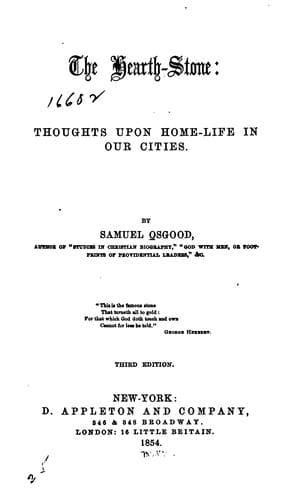
The Hearth-Stone: Thoughts Upon Home-Life in Our CitiesOsgood, Samuel
Religion
The Hearth-Stone: Thoughts Upon Home-Life in Our Cities
Osgood, Samuel
Christian life; Conduct of life
peace, and motive and time for the higher aims of life.
What shall increase the national wealth and distribute it with due justice
in the homes of the people? Communism? Not so; for destroying the very
idea of property is not the way to increase the aggregate of property. Who
will work, if his gains are not secured to him and his children? Who will
plant the grain or the vine, if the field or the vineyard is to be an open
pasture, which any idler may waste? The way to enlarge and distribute
wealth is rather to strengthen the foundations of property, and give all
motive to earn their share of it by labor, temperance, and economy.
Here we believe that every nation is bound to apply the force of law to
reach the root of the difficulty. I am not proposing to discuss the
various projects set on foot to insure the more equable distribution of
property--such as the homestead laws of some of our own States, or the
measures in train to redeem the peasants of Ireland from their slavish
penury. Very certain it is, that we need to watch jealously the
distribution of the public lands, to keep them from the grasp of avarice
and intrigue, and to hold out the utmost inducements to actual settlers to
till and own the soil. It is interesting to find that upon this one point,
the most sanguine of the Land Reformers have much countenance from the
most judicious conservatives, and the wary sagacity of Webster himself
saw no peril in securing a part of the national domain to every
persevering cultivator. It is also interesting to observe that, whilst the
ultraist advocates of a protective tariff have signally lowered their
tone, some of the most earnest advocates of free trade, as the only
philosophical theory, are favoring such judicious protective duties as
shall tend to bring the producer and consumer near together, check the
wastefulness of needless transportation, and thus prepare the way for the
final triumph of free trade by the action of associative industry. All
such expedients however good in themselves, are of no avail apart from a
broad and energetic policy that meets the difficulty in the face. We mean
the education of the entire people in schools open to all the children of
the nation. Thus we reach the home--thus we open the eyes and quicken the
energies of the people--thus we enlarge the products of intelligent labor,
and guard against the worst evils of human inequality. Thus we open the
way for a better social science and organization, and favor the associated
enterprise, which is the best safeguard against communism. The educated,
industrious population will take their own lot into their own hands, and
by practising a truer philosophy of accommodation, they will apply in
their home economy something of that wise policy which has been left too
exclusively to the use of the favored few. The architecture of the house,
and the arrangements of the neighborhood, will show the influence. Whilst
Public-domain text, read in full here on John Shaqi.
Reviews
Reviews
No reviews yet
Be the first to share your thoughts on this work.
Join the Discussion
Join the discussion
Sign in to leave a comment or review.
Sign InorCreate an account