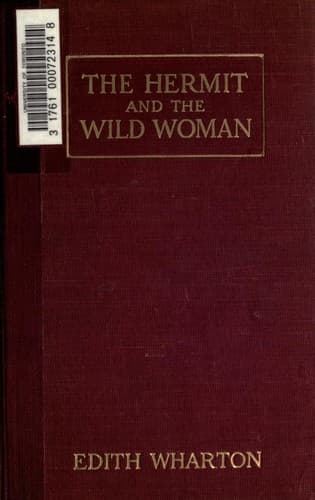
The Hermit and the Wild Woman, and Other StoriesWharton, Edith
General
The Hermit and the Wild Woman, and Other Stories
Wharton, Edith
Short stories, American
The city itself seemed to have made as little impression on him as its
speech. He appeared to have no artistic or intellectual curiosities, to
remain untouched by the complex appeal of Paris, while preserving,
perhaps the more strikingly from his very detachment, that odd American
astuteness which seems the fruit of innocence rather than of
experience. His nationality revealed itself again in a mild interest in
the political problems of his adopted country, though they appeared to
preoccupy him only as illustrating the boundless perversity of mankind.
The exhibition of human folly never ceased to divert him, and though
his examples of it seemed mainly drawn from the columns of one exiguous
daily paper, he found there matter for endless variations on his
favorite theme. If this monotony of topic did not weary the younger
man, it was because he fancied he could detect under it the tragic
implication of the fixed idea--of some great moral upheaval which had
flung his friend stripped and starving on the desert island of the
little cafe where they met. He hardly knew wherein he read this
revelation--whether in the resigned shabbiness of the sage's dress, the
impartial courtesy of his manner, or the shade of apprehension which
lurked, indescribably, in his guileless yet suspicious eye. There were
moments when Garnett could only define him by saying that he looked
like a man who had seen a ghost.
II
AN apparition almost as startling had come to Garnett himself in the
shape of the mauve note received from his _concierge_ as he was leaving
the hotel for luncheon.
Not that, on the face of it, a missive announcing Mrs. Sam Newell's
arrival at Ritz's, and her need of his presence there that afternoon at
five, carried any special mark of the portentous. It was not her being
at Ritz's that surprised him. The fact that she was chronically hard
up, and had once or twice lately been so brutally confronted with the
consequences as to accept--indeed solicit--a loan of five pounds from
him: this circumstance, as Garnett knew, would never be allowed to
affect the general tenor of her existence. If one came to Paris, where
could one go but to Ritz's? Did he see her in some grubby hole across
the river? Or in a family _pension_ near the Place de l'Etoile? There
was no affectation in her tendency to gravitate toward what was
costliest and most conspicuous. In doing so she obeyed one of the
profoundest instincts of her nature, and it was another instinct which
taught her to gratify the first at any cost, even to that of dipping
into the pocket of an impecunious newspaper correspondent. It was a
part of her strength--and of her charm too--that she did such things
naturally, openly, without any of the ugly grimaces of dissimulation or
compunction.
Public-domain text, read in full here on John Shaqi.
Reviews
Reviews
No reviews yet
Be the first to share your thoughts on this work.
Join the Discussion
Join the discussion
Sign in to leave a comment or review.
Sign InorCreate an account